How to write X hooks that stop the scroll
The short answer
A good X hook is a first line that tells the right reader who it is for, gives one specific detail to believe, and leaves out the one thing the rest of the post supplies. Put that detail in the first five words or so, and cut every warm up before it.
Key takeaways
- A hook is the first line of a post, and it has three jobs: show who it is for, give a detail to believe and open a gap the post closes.
- Readers scan before they read, so put the number, name or turn in the first few words and delete any warm up.
- Seven structures cover most hooks: a result, a number, the cost of a lesson, a contrarian view, a scene, a how to promise and a question.
- A hook may only promise what the post delivers. A gap the post never closes is bait.
- Grade the line against a checklist, then read it aloud. A grade checks the writing. It does not predict reach.
You open the composer with a good idea and write it the way you would say it to a friend: "So I just wanted to share a few thoughts on invoicing." The idea is fine. The first line is a warm up, and the reader scrolling past never reaches the second one. The first line is one part of writing great X posts.
Good X hooks fix that. A hook is the first line of a post, written so the right reader stops and reads on. This guide covers what a first line has to do, seven structures that do it, rewrites you can borrow, and a ten minute routine for your next draft. A thread's opener has its own job; our guide to the first post of a thread covers it.
What is a hook on X
A hook is not a trick and not a separate sentence you bolt on. It is the opening of the post you were already going to write, rewritten so that it earns the second line.
It is also a line, not a paragraph. The Kairo Post hook grader grades only the first line, up to the first line break, because that is what a reader meets first. If your opening is a long block, the whole block is the hook, and that is usually the problem.
| A hook is | A hook is not |
|---|---|
| The first line, rewritten once you know the point | A sentence added before your real opening |
| A detail that tells the right reader this is theirs | A line built to catch everyone |
| A promise the rest of the post keeps | A gap the post leaves open |
| Plain words you would say aloud | Announcer voice and buzzwords |
Why the first line decides whether anyone reads on
People scan a feed before they read any of it. The best evidence we found is a web usability finding, not an X statistic: Jakob Nielsen reported in 2009 that users typically see about 2 words of each item when they scan a list, and a little more if the lead words are short.
A timeline is a list of openings. We have no reason to think readers treat it differently, but treat the number as a direction, not a law.
2
words a scanning reader typically sees of each list item
Nielsen Norman Group, 2009. Web lists, not X.
280
weighted characters in a standard post
X developer documentation
23
characters one link costs, however long it is
X developer documentation
5 to 14
words that score full marks for length in the hook grader
Kairo Post hook grader
For writing, we plan around the first five words. That is our working window, and the same window the hook grader scores. It is a bit more generous than Nielsen's 2 words and it works as a test: if the first five words carry no number, name, contrast or promise, the line is relying on the reader to be patient.
Nielsen Norman Group calls the same idea the inverted pyramid: put the most important information first, so the reader gets the point however little they read. A hook is that rule applied to one line.
Does this apply to longer posts?
X's Help Center says Premium subscribers can post up to 25,000 characters. We found no X page that says where the timeline cuts a post that long, so we do not quote a cut off. What does not change is the rule: whatever a reader sees first has to make sense without the rest.
The three jobs of a good hook
A strong first line does three things in a few words. It tells the right reader the post is for them, it gives one detail worth believing, and it leaves out the one thing the rest of the post supplies.
- Who it is for. The reader decides in a glance whether this is theirs. "Freelance designers:" does it. So does "Our checkout went down" for anyone who runs one.
- Why believe it. A number, a name, a time or a place. Nielsen Norman Group's headline advice is to be specific and give concrete information, not broad claims.
- What is missing. A gap the post closes. In George Loewenstein's information gap theory, curiosity comes from noticing a gap in what you know.
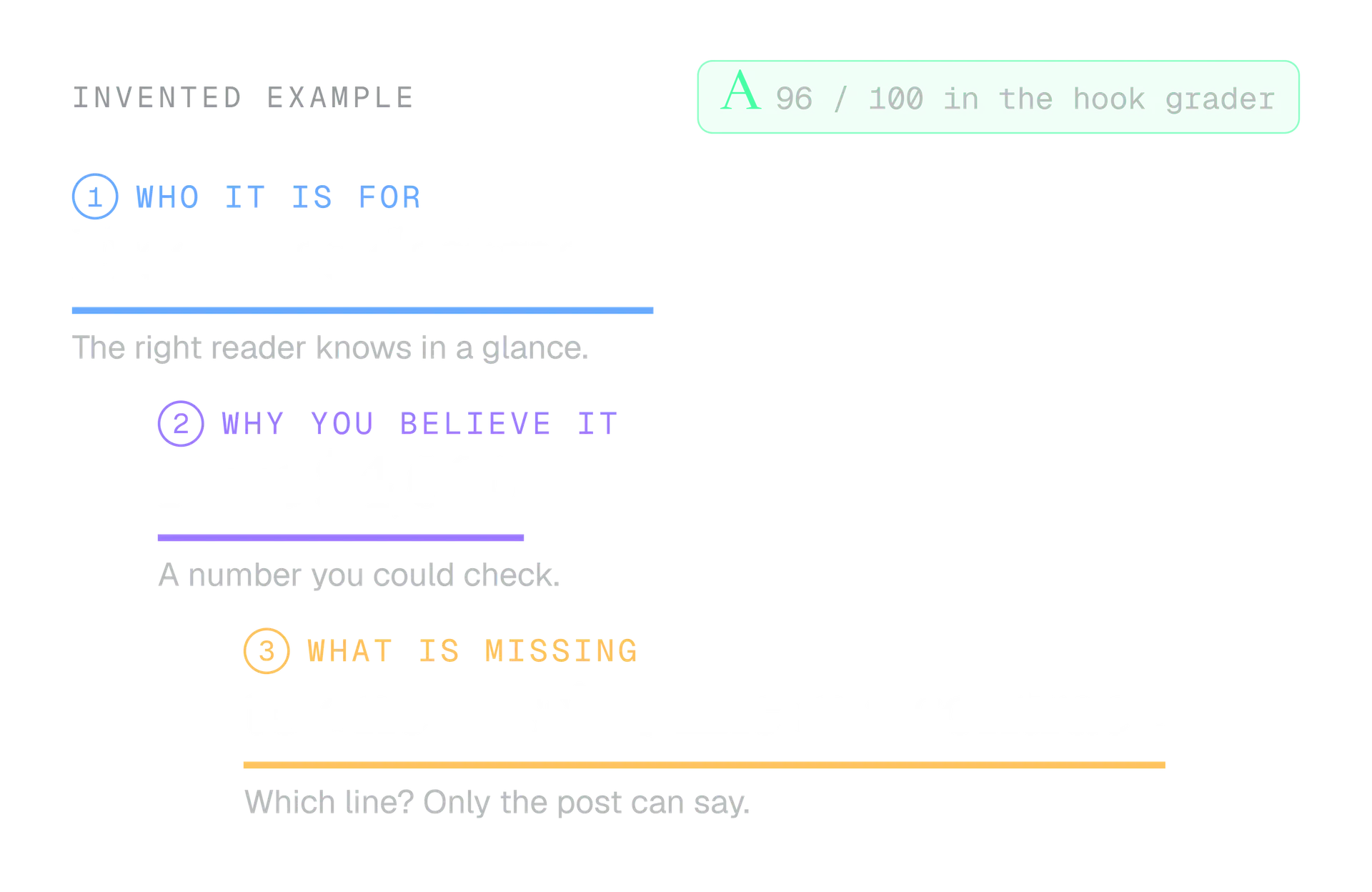
The third job is the one people skip. A line that states everything has no gap, and nothing pulls the reader down. A line that states nothing has a gap with nothing to hold onto. A summary of Loewenstein's paper notes that curiosity depends on existing knowledge, so the gap has to be about something your reader half knows.
That is why "Freelance designers: I lost $4,000 to one missing line in a contract" works as a shape. Every designer knows what a contract is. Nobody knows which line, yet.
Seven X hook structures and when each one works
Seven shapes cover most hooks. Choose by what you actually have, not by what is fashionable this month. All examples here are invented.
The first three lead with a fact.
Lead with what changed
Result
Say what changed and by how much. It works when you have a real before and after. Example: "Our checkout now loads in 1 second, down from 6."
Lead with one measurement
Number
Open with one measured thing and make the reader want the reason. It works when the number is surprising. Example: "Our newsletter had 12 sections. Readers only ever clicked the first."
Lead with what it cost you
Cost of a lesson
Name what the lesson cost. The cost is the proof. It works when you lost something real. Example: "I lost a client over one late reply. Here is the rule I set afterwards:"
The next four lead with a person or a point of view.
Disagree, and say with whom
Contrarian
Disagree with common advice and say who it fails. It works when you can name the case. Example: "Stop A/B testing button colours until your page has one clear offer."
Start in the middle
Scene
Open inside a moment, with a time or a place. It works when the story has a turn. Example: "The client call started at 9. By 9:05 we knew the report was wrong."
Promise a method and its size
How to promise
Promise a method and say how big it is. It works when the post is a process or a list. Example: "How to write a cold email in 4 sentences: the exact structure I use."
Ask what they are wondering
Question
Ask the thing your reader is quietly asking themselves. It works when they have the problem and no answer yet. Example: "Why do your best posts get fewer replies than your worst?"
Not sure which one to pick? Start from what you have.
| You have | Start with |
|---|---|
| A before and after you can measure | Result or Number |
| A mistake that cost you something | Cost of a lesson |
| A view that differs from the usual advice, and a case where it holds | Contrarian |
| A story with a turning point | Scene |
| A method with clear steps | How to promise |
| A problem your reader recognises and you answer in the post | Question |
The hook grader has a library of templates for launches, lessons, contrarian takes, data, stories and how to posts. Copy a template, replace every bracket with a true detail, then grade it.
Hook examples: weak first lines and their rewrites
Each rewrite below keeps the facts and changes only the opening. The product, Fernwick, is made up, and so is every number. The grades are from the hook grader as it works on 1 October 2026.
Weak: grade D, 65 out of 100
Excited to announce our new AI powered scheduling feature!
It opens with a feeling and a label. The reader learns nothing about what changed for them.
Rewrite: grade B, 84 out of 100
A wrong time zone cost one Fernwick customer a launch day. It cannot happen now.
It starts with the problem, names a cost, and the second sentence is the news.
Here is how that rewrite looks as a post, with the rest of the announcement underneath. The hook sets up the problem, and the body pays it off straight away.
A wrong time zone cost one Fernwick customer a launch day. It cannot happen now.
Posts now go out in your audience's time zone, not yours. You pick the audience once, and the schedule does the maths.
The second pair is a lesson post. The weak version is an opinion with no evidence behind it.
Weak: grade F, 48 out of 100
I think consistency is really the most important thing in content.
"I think" and "really" are filler, and nothing in the line can be checked or pictured.
Rewrite: grade B, 86 out of 100
I posted daily for 90 days and gained 40 followers, but one change fixed it.
A number, a duration and a turn. The reader wants to know what the change was.
The third pair is a how to post, where the weak line promises a list and the rewrite promises a size.
Weak: grade C, 72 out of 100
Here are some tips for writing better emails.
"Some tips" has no number, no cost and no reader. It could open a thousand posts.
Rewrite: grade B, 87 out of 100
How to write a cold email in 4 sentences: the exact structure I use.
It promises a method, a size and a source. The reader knows what they get before they decide.
Notice what did not change. Fernwick is still the same product, the lesson is the same lesson, and the email advice is still email advice. A rewrite moves the strongest detail to the front. It does not add new claims.
How to rewrite a first line, one edit at a time
Many weak hooks improve in a few edits, and each edit fixes one thing. Here is one invented line taken from a grade F to a grade A in three edits, with the score the hook grader gave at every step.
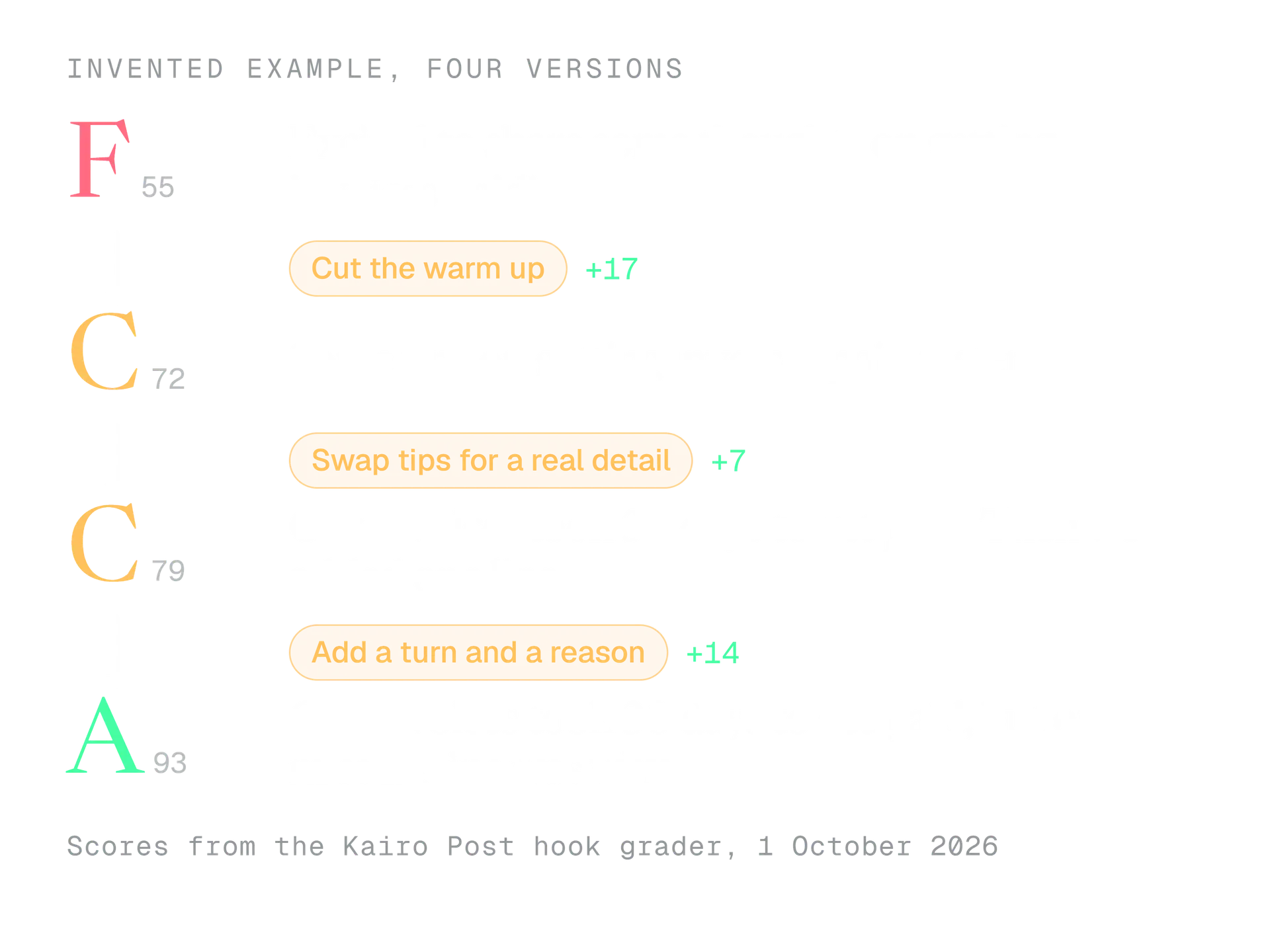
Here is what moved at each edit, using the three rules that changed.
| Edit | Specificity | Tension | First five words |
|---|---|---|---|
| 1. Cut the warm up | 15 to 15 | 20 to 65 | 20 to 75 |
| 2. Swap tips for a real detail | 15 to 90 | 65 to 20 | 75 to 80 |
| 3. Add a turn and a reason | 90 to 90 | 20 to 90 | 80 to 80 |
The middle edit is the useful one. Swapping "tips" for a real detail lifts specificity from 15 to 90, but tension drops from 65 to 20, because "tips" was doing a small amount of promising. The line only reaches an A when the third edit puts a turn back: "but one missing line was why".
In rewrites like this, one edit repairs a weakness and exposes the next.
The first edit is the easiest to make and the easiest to skip: cut everything before the first detail.
How to write a hook in 10 minutes
Write the post first and the hook last. You cannot open a gap before you know what fills it.
Write the post, then find the one detail
Find the number, name, scene or cost that only you have. It is usually already in the draft, in the third or fourth sentence.
Write the line three ways
Use three different structures from the cards above. Do not judge them yet. The aim is to see how different the same fact can sound.
Cut the warm up
Delete everything before the first detail. Words like "just", "really" and "I think" add length and push the interesting part further away.
Check the first five words
Is there a number, a name, a contrast or a promise in them? If not, move one forward.
Grade it, then read it aloud
Paste the line into the hook grader, open the weakest rule and fix that one only. Then say the line out loud. If you would not say it to a colleague, rewrite it.
Check the payoff
Read the line, then the second line. Does the second line answer what the first one opened? If it does not, the hook promises something the post does not give.
Kairo Post can help when you want several openings to compare. You can ask the AI Agent for a stronger hook while the facts stay the same, then pick one. Nothing publishes without your approval. The AI Agent page shows how.
Hooks that promise too much, and other mistakes we see
A hook is only as good as the post under it. When the line opens a gap and the post closes it, the reader gets what they were promised. When the post does not, they leave, and they remember.
Nielsen Norman Group makes the same point about headlines: write them so they make sense out of context, and choose clarity over hype or clever wording. We think a reader let down by one teaser has less patience for the next.
These are the mistakes we see most often:
- The warm up. "So I wanted to share" spends the first five words, the ones most readers see, on nothing.
- The announcement voice. "Excited to announce" tells the reader how you feel. They want to know what changed for them.
- The vague promise. "Some tips" has no number, no cost and no reader.
- The unpaid hook. The line opens a gap the post never closes.
- The borrowed template. The brackets are filled with vague words, so the line sounds like everyone else's.
- The same shape every time. A number and a colon on every post turns a pattern into a habit your followers notice.
- The link in line one. It costs 23 characters and gives a scanning reader nothing.
What a hook score can and cannot tell you
The hook grader is a checklist written as code. It scores six rules from 0 to 100 and weights them into a total, with 90 and above an A, 80 a B, 70 a C and 60 a D.
| Rule | Weight | What it looks for |
|---|---|---|
| Specificity | 20 | Numbers, amounts, names, products, @handles |
| Tension or promise | 20 | A contrast, a promise word, a question or a colon payoff |
| Length | 15 | 5 to 14 words scores full marks |
| Clarity | 15 | Loses points for jargon, shouting and very long words |
| Filler words | 15 | Loses points for words like just, really and I think |
| First five words | 15 | Rewards a strong start, punishes warm ups |
That makes it good at catching weak lines. It also means it can be wrong in both directions, and you should know where.
| Scores low, reads well | Scores high, may be empty |
|---|---|
| Remote teams do not need more meetings. They need fewer decisions per meeting. (D, 60) | Freelance designers: I lost $4,000 to one missing line in a contract. (A, 96) |
| A clear point of view and a good rhythm, but no number, no name and none of the contrast words the grader looks for | Every rule is satisfied, and the grader cannot tell whether the $4,000 is real or invented |
| We would keep it for the right account | We would keep it only if the story is true |
The grader cannot judge truth, and it cannot judge fit. It also does not know your audience, your topic or your timing. We have no data that says a B outperforms a C on X, so we do not claim it. Use the grade to find the weak rule, then use your judgement on the rest.
Before you post: a hook checklist
Run this on the first line of every post. It takes under a minute once you have done it a few times.
Is this hook ready?
- It opens with a number, name, time, place, contrast or promise, not a greeting.
- The right reader can tell in five words that the post is for them.
- Every detail in it is true, and rounded numbers say about.
- It leaves out one thing the post supplies, so there is a reason to read on.
- The second line answers what the first line opened.
- There is no link, filler word or jargon in it.
- It reads like something you would say aloud.
- It does not use the same shape as your last three posts.
Draft a hook, grade it in the hook grader, fix the weakest rule, then check the full post with the AI phrase checker to catch the stock phrases that sneak into the body. When you are ready to publish, count the final post in the character counter, link and all.
In the product
How Kairo Post does this
Everything above works by hand. Kairo Post does the same work for you, with your approval before anything goes out.
Questions people ask
How long should an X hook be?
Should an X hook be a question?
Is a hook the same as clickbait?
Do replies need a hook?
Can I use a hook template?
Does a high hook grade mean the post will do well?
Sources
Every rule, limit and figure in this post was checked against these on the date shown.
- Counting Characters, X developer documentation
docs.x.com · checked
- About different types of Posts, X Help Center
help.x.com · checked
- First 2 Words: A Signal for the Scanning Eye, Nielsen Norman Group
nngroup.com · checked
- Inverted Pyramid: Writing for Comprehension, Nielsen Norman Group
nngroup.com · checked
Written by