How to handle negative comments on X
The short answer
Sort each comment first: fair criticism, a real problem, a misunderstanding, trolling, or abuse. Answer the first three once in public and move details to DMs, mute or hide trolls, block and report abuse, and never delete or hide fair criticism.
Key takeaways
- Sort before you reply. The kind of comment decides the move, not how it feels.
- Answer fair criticism and real problems once in public, then take private details to DMs.
- Hiding a reply does not delete it. Anyone can still open it, so keep hiding for abuse and spam.
- A blocked account cannot engage with you, but it can still see your public posts.
- Threats get saved, reported and, if you fear for safety, taken to law enforcement. Never argue with them.
Someone has replied to your post with something harsh, and you are about to type back. Stop for a minute. Negative comments on X are not one thing, and the right move depends on which kind you are looking at. This is one part of community management on X. To narrow who can answer before a pile on starts, see how to control who can reply.
This guide gives you a quick way to sort each comment. Then it covers what to answer in public, what to move to DMs, and when to hide, mute, block or report, using only the tools X documents. It ends with an escalation path for a team and a checklist. Keep it calm. Most of the time the calm answer is also the best one.
The five kinds of negative comments on X
Sort first. Each kind has a different best move, and mixing them up causes the two classic mistakes: arguing with a troll, and hiding a customer who was right.
Answer, keep visible
Fair criticism
An honest opinion about your product, your post or your behaviour, even a rude one, that you can partly agree with. Thank it, say what you will do, and leave it up.
Fix, then DM
A real problem
A late order, a bug, a missed message. It is a support case in public clothes. Acknowledge it once and move the details to DMs.
Clear up once
A misunderstanding
They have a fact wrong or missed a detail. Give the right fact kindly, with a link if one helps, and do not correct them twice.
Do not feed
Trolling
No question, no detail, no point. The aim is a reaction. Mute the account, hide the reply or ignore it.
Protect, then report
Abuse or threats
Insults aimed at a person, targeted harassment, or any threat of violence. Block, save the evidence and report.
Ask two questions, in this order. Does it abuse or threaten a person? If yes, stop sorting and protect people first. If not, is there anything true or answerable in it? If yes, it is one of the first three kinds. If no, it is trolling.
Judge the words, not the temperature. Fair criticism is often rude, and trolls are sometimes polite. A sharp tone from a customer who is right still belongs with the first three kinds.
What to answer in public and what to move to DMs
Answer once in public, then move the details to DMs. The public reply is for everyone reading the thread. The DM is for the person.
| Say it in public | Move it to DMs |
|---|---|
| That you saw it, and that you are looking into it | Order numbers, emails, addresses and account details |
| A correction of a public fact, with a link | Refunds and anything about money |
| What you changed because of the feedback | A long back and forth to find out what went wrong |
| Thanks for fair criticism | Anything that concerns only that one person |
X backs the privacy half of this. Its automation rules say not to ask people to send personal or private information in a public post, and to use Direct Messages instead. Its private information policy also bans posting other people's private details, such as a home address or phone number, without their permission.
Two habits make this work. First, never answer only in DMs. Everyone who reads the thread sees silence, and silence looks like ignoring the person. Second, close the loop in public. When it is fixed, add one line under your first reply, such as "Sorted. Thanks for flagging it."
Fair criticism: answer it, and never delete it
Fair criticism is the most useful negative comment you will get, and the one people most want to remove. Resist that. Answering it in the open shows every reader how you behave when you are wrong.
Read it as a stranger would
Look at the comment without the history. Would a neutral reader think the person has a point?
Name the true part
Start with what is right: "You are right that the update broke search." Do not start with "but".
Say what happens next, or why nothing will
A date, a fix, or an honest "we decided not to, and here is why". Either beats silence.
Reply once, then stop
One clear answer is enough. If they push back, a second reply is fine, a fifth is a fight.
Come back when something changes
If you fix it, say so under the original comment. That closing reply is often the most persuasive post of the week.
Hiding fair criticism feels different from deleting it, but readers see little difference. X says hidden replies stay accessible through an icon on your post, so anyone curious is one click from the very thing you hid. Keep hiding for abuse and spam.
A real problem or a misunderstanding: what to say
A real problem needs three things in the public reply: you saw it, you are sorry or sorry it happened, and the next step. A misunderstanding needs one thing: the right fact, said kindly.
Here is a made up customer comment and two ways to answer it.
Third time my order has turned up late and nobody at @example_cycles has said a word. Embarrassing.
Acknowledge, own it, move it
You are right, and that is not good enough. Sorry. Please DM us your order number and we will look into it today.
Defend, deflect, quote the policy
We have been very busy and most customers are happy. As our shipping page says, delays can occur.
A misunderstanding needs a lighter touch. The person is not attacking you, they are wrong, and an answer that treats them like an attacker turns a small error into a fight.
Not quite. The Roam bike keeps its price. Only the Trail bag changed, and the reason is in our post here. Happy to answer anything it leaves out.
Notice what is missing: "actually", "clearly" and "as we said". Those words sound like you are annoyed, even when you are not. Our guide to brand voice on X covers how a reply should sound.
When to hide, mute, block or report on X
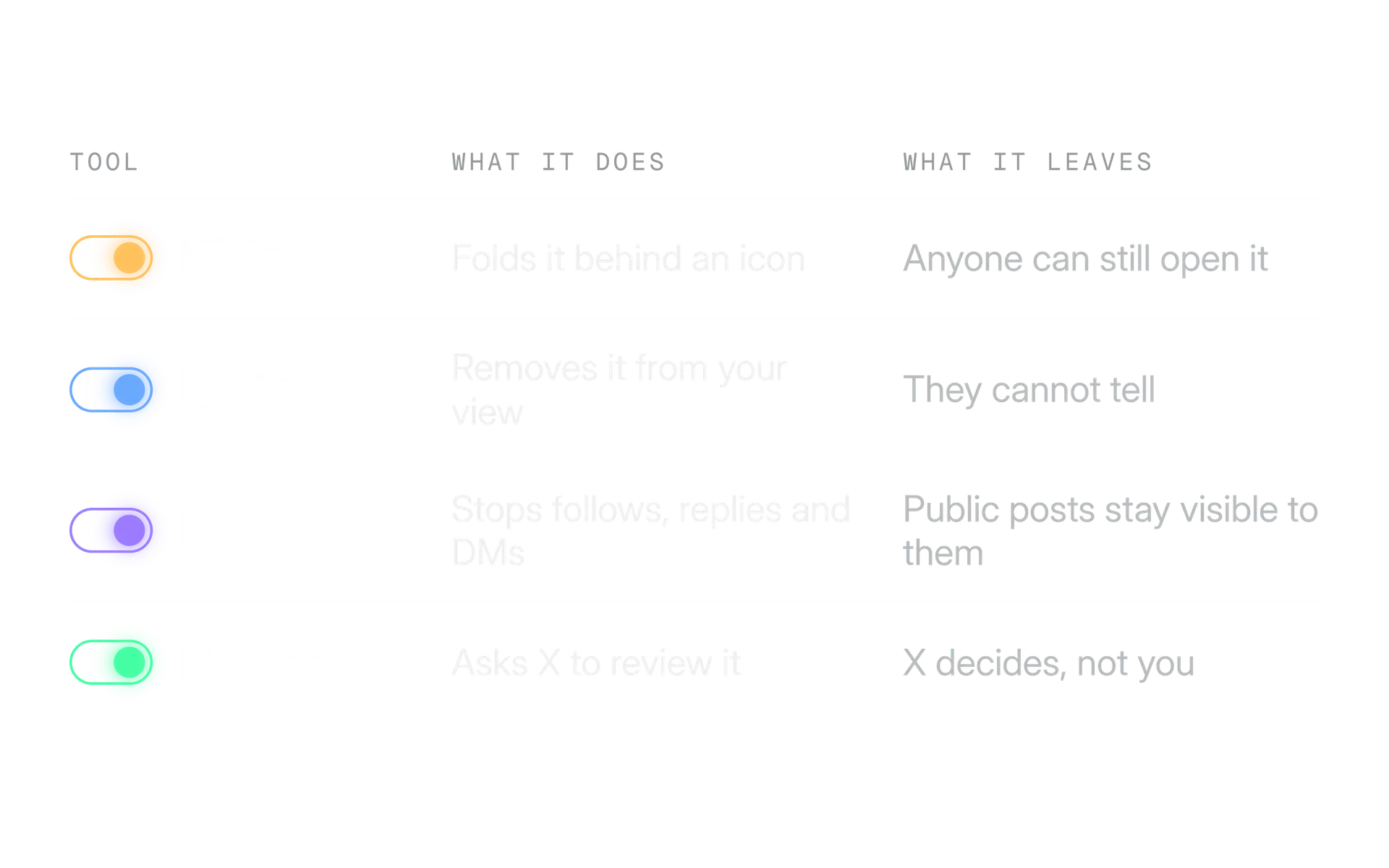
Use the lightest tool that solves the problem, and use the heavier ones for abuse, not disagreement. X gives you four main tools: hide a reply, mute, block and report. They do different things, and people often expect more from them than they deliver. To keep a pile on out of your notifications, see how to mute words and accounts on X.
Hide a reply
Only the author of a post can hide replies to it. Use it for abuse, spam and obvious bait, never for a reply that is merely harsh and true.
- It is not deleted. The reply sits behind a hidden reply icon on your post and needs an extra click to read. Anyone can still open it.
- The person is not told. X's Help Center says the author of a hidden reply is not notified, and you can unhide it at any time.
- How: open the menu on a reply to one of your posts, choose hide reply and confirm.
Mute
Muting changes what you see, and nothing else. X says a muted account has no way to tell it was muted.
- Mute words. You can mute posts that contain particular words, phrases, usernames, emojis or hashtags. They apply to your notifications and Home timeline.
- Choose how long. The mute can last forever, 24 hours, 7 days or 30 days.
- Mute a conversation. You stop getting new notifications from that thread and can still read it.
We could not confirm from X whether muted accounts still reach your notifications when they mention you, so test mute on a spare account if your plan depends on it.
Block
Blocking stops an account from following you, engaging with your posts (like, reply, repost) or sending you a Direct Message. The account is not told.
- It can still look. Since a change in 2024, which TechCrunch reported, a blocked account can still see your public posts. Protected posts stay hidden from them.
- Use it on repeat offenders. X's own advice on a reply you do not like is to stop engaging, and to block the account if the behaviour continues. Block when someone keeps coming back, not on the first sharp comment.
Report
Report when a comment breaks X's rules, not when it only stings.
- Open the more icon on the post and choose Report.
- Say whether it is about you, someone else or everyone on X.
- Add detail. X may ask you to select more posts from the account for context.
- Afterwards, X offers to mute or block the account too.
Quieter tools for a pile on
When a post draws a crowd, you can change who can reply, even after you have posted. Open the More icon on the post and choose "Change who can reply". The four settings are in our guide to using replies to grow on X.
You can also switch on the notifications quality filter, which filters lower quality content such as duplicates or automated posts but does not filter people you follow. Advanced filters can mute notifications from accounts you do not follow, new accounts and default profiles.
How to deal with trolls, abuse and threats
These three get lumped together, and they should not be. A troll wastes your time. Abuse hurts people. A threat may be a safety issue. Each one gets a different first move.
| First move | Then | Never | |
|---|---|---|---|
| Troll | Do not reply. Mute or hide. | Move on to the next real question. | Answer to "win" in front of the audience. |
| Abuse | Block, and save a screenshot. | Report the post. | Quote the abuser to rally your followers. |
| Threat | Save the evidence, do not reply. | Report it, and tell your team. | Argue, or ignore it as just noise. |
X weighs context when it decides on action. Its abuse policy lists what it considers, so report with detail and not just a click:
- How severe the violation is.
- Whether someone has been targeted, for example mentioned, named in full or shown in a photo.
- The account's previous record of rule violations.
For threats, X's rule is short: "You may not threaten violence against an individual or a group of people." X also says public interest exceptions are unlikely for content that threatens or glorifies violence. If you believe someone is in danger, do not wait for X. Contact local law enforcement.
X's guidance for that call is to document everything:
- Screenshots or print outs of the messages.
- Why you are concerned, in specific terms.
- Anything you know about who might be involved.
- The post link and the time you saw it.
Do not post an abuser's private details to "expose" them, however angry you are. X's private information policy covers that, and it turns you from the person wronged into someone who broke a rule. Our plain guide to X rules for brands and creators maps the rules that apply to you.
An escalation path for a team
The hard part of a bad reply is rarely writing it. It is not knowing who is allowed to decide. Agree the path before you need it, and write it down where everyone on the account can see it.
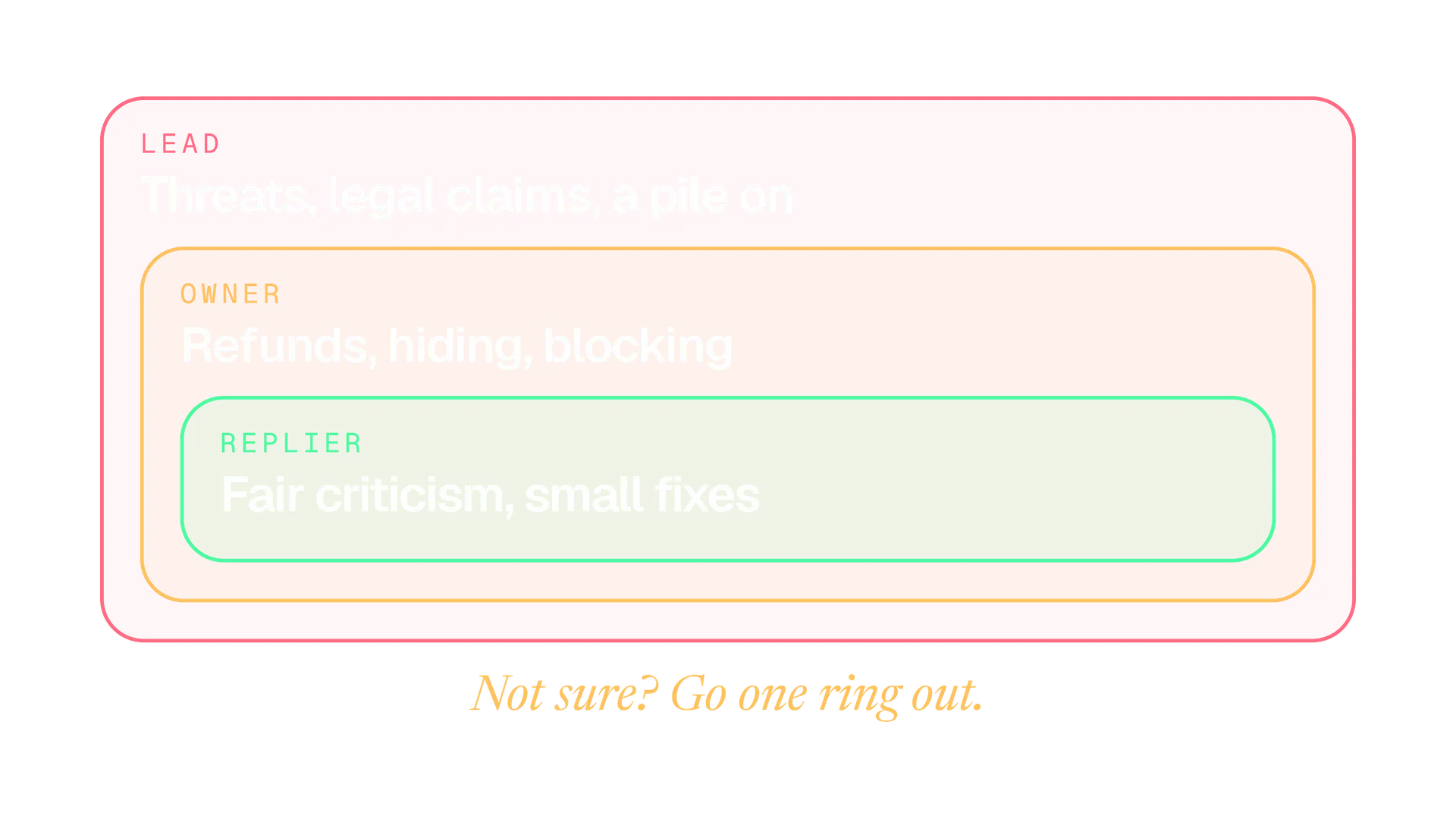
Then give the path a clock. These times are our rule of thumb, not an X rule.
First 10 minutes
Sort and pause
Put it in one of the five kinds. If it is abuse or a threat, protect people and save evidence before anything else.
Within the hour
Answer once, or act
Send the public reply for kinds one to three, or use the right X tool for the rest. Move private details to DMs.
Same day
Close the loop
Add the closing line in public. Write a short note of what happened, who decided and what you did.
Next working day
Look for the pattern
Is it the same complaint again? Pass it to whoever owns the product, the shipping or the post that started it.
If several people share an account, Kairo Post's inbox collects the mentions, replies and DMs of your accounts in one place, sets DM spam aside and lets you assign a conversation and leave internal notes. It drafts a reply in your voice, but a person always decides what gets sent. Hiding, muting, blocking and reporting still happen in X itself.
If you answer for clients, add a line about it to your agreement. Our guide to managing X for clients covers what to settle in writing before the first post.
Mistakes we see with negative comments
These come up again and again, in every kind of account.
- Hiding fair criticism. It is the quickest way to turn a small complaint into a story about you.
- Replying before sorting. Most bad replies are fast replies. Sort first, then write.
- Arguing the same point three times. One answer, one follow up, then stop.
- Replying to a troll for the audience. Readers notice who stays calm, and it is rarely the one still typing.
- Asking for private details in public. Order numbers and emails belong in a DM.
- Letting one person decide everything. When they are away, the account has no rules. Write the path down.
- Treating every sharp comment as abuse. Reporting disagreement wastes your reports and teaches you nothing.
A checklist for the next negative comment
Keep this next to the account. Read it top to bottom before you press reply.
Before you answer
- I have read it as a stranger would, not as the person it stings.
- It is one of the five kinds, and I know which.
- If it is abuse or a threat, I have saved a screenshot and the link.
- If it is fair criticism, I am not hiding or deleting anything.
- My public reply says what I saw, what I will do and nothing more.
- Private details are going to DMs, not into the thread.
- I know who to hand it to if I am not sure.
- I will add a closing line when it is fixed.
Next, look at the habits around the comments: how you reply to people who are happy with you, and how you grow through replies. That is where most of the good conversations on X start, and our replies guide is the place to begin.
In the product
How Kairo Post does this
Everything above works by hand. Kairo Post does the same work for you, with your approval before anything goes out.
Questions people ask
Should I delete a negative comment on X?
Does X tell a person when I hide their reply?
What is the difference between muting and blocking someone on X?
Should a brand reply to trolls?
When should I report a comment on X?
Can I use a tool to hide negative replies automatically?
Is it fine to answer a complaint only in DMs?
Sources
Every rule, limit and figure in this post was checked against these on the date shown.
- Hide Replies, X developer documentation
docs.x.com · checked
- About replies and mentions, X Help Center
help.x.com · checked
- Blocking on X, X Help Center
help.x.com · checked
- How to use advanced muting options, X Help Center
help.x.com · checked
- About online abuse, X Help Center
help.x.com · checked
- How to report abusive behavior on X, X Help Center
help.x.com · checked
- Abuse and harassment, X Help Center
help.x.com · checked
- Public interest exceptions to enforcement of X rules, X Help Center
help.x.com · checked
- Automation rules, X Help Center
help.x.com · checked
- X updates block feature, letting blocked users see your public posts, TechCrunch
techcrunch.com · checked
Written by