The words that make writing sound like AI
The short answer
Six kinds of wording make writing sound machine made: filler openers, inflated verbs, hype words, hedges, cliché closers and stock sentence shapes. They signal padding, not who wrote a post, so swap each for a plain word or a concrete detail.
Key takeaways
- Six types of wording make a draft read as machine made: filler openers, big verbs, hype words, hedges, cliché closers and stock sentence shapes.
- A 2025 study of biomedical abstracts found 454 words used far more than expected in 2024, and 66% of the 379 style words among them were verbs.
- No word proves AI wrote a post. Detectors are unreliable, and the same habits appear in editorials, blogs and fan fiction.
- Fix a tell by adding a detail, not by swapping in a synonym. A new word for the same empty claim is still empty.
- Keep a flagged word when you mean it and no plainer word is as exact.
You read your draft back and nothing is wrong with it. Every sentence is fine. Together they sound like every other post in the feed: a warm up opener, a big verb, a hedge and a closing question nobody asked. For the whole workflow, from brief to approval, see our practical guide to AI writing for X.
Those are the AI words to avoid. This list sorts them into six types, gives each a plain rewrite, and says what the research does and does not show. One rule first: no word on this list proves who wrote a post. They are signs of padding, and readers skim padding whoever produced it. Plenty of padding is human too; see filler words to cut from your X posts.
Why do some words make writing sound like AI
Language models lean on some words far more than people do, and readers have started to notice. The clearest evidence comes from science writing, where researchers could count.
A team led by Dmitry Kobak looked at more than 15 million biomedical abstracts from 2010 to 2024. For every word they compared 2024 use with what the 2021 and 2022 trend predicted. After chatbots arrived, a set of style words rose far above that line.
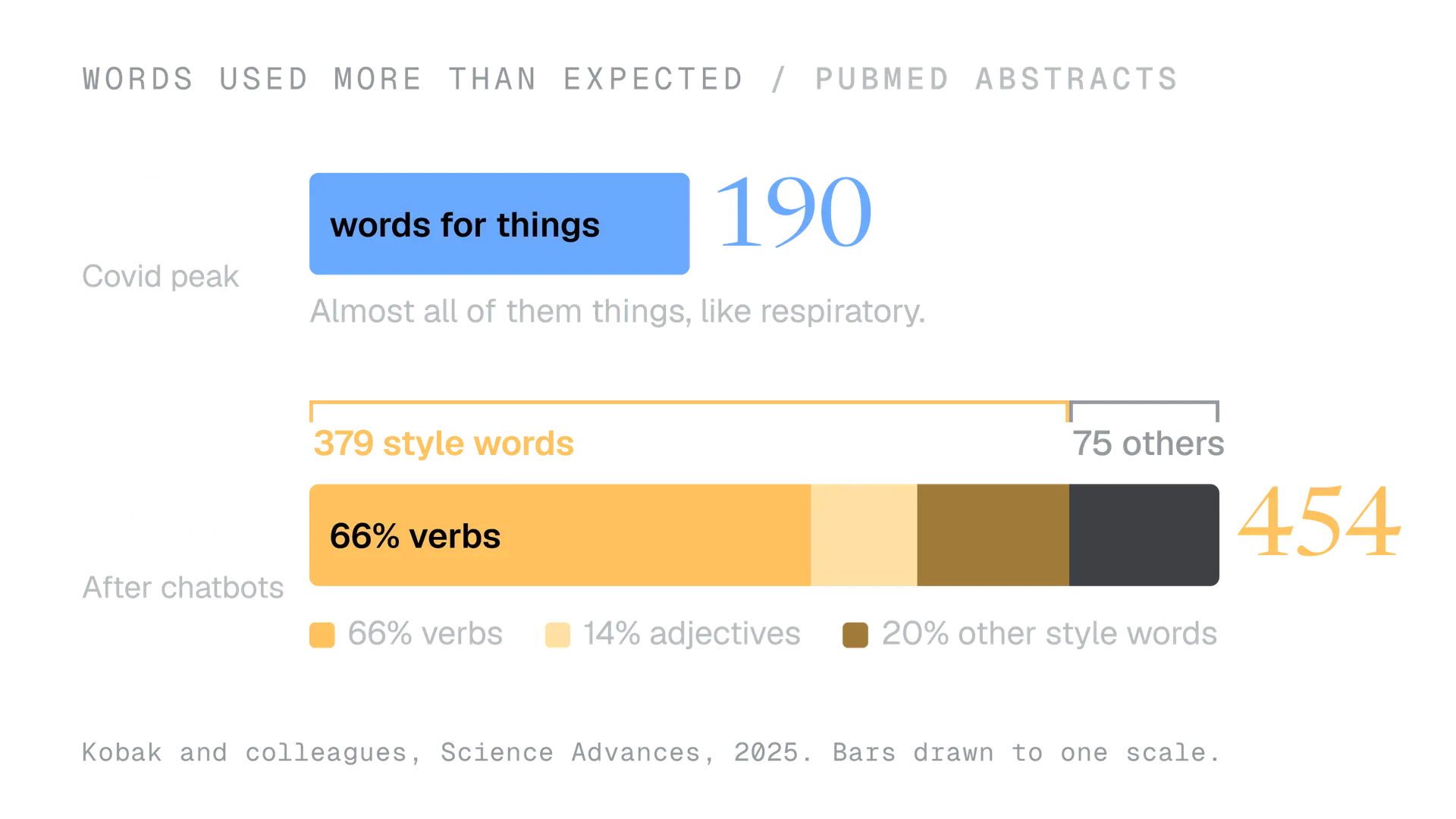
The kind of word changed, not only the number. The excess in the Covid years was things, like "respiratory". The excess in 2024 was almost entirely style words, and 66% of those 379 words were verbs.
190
words used more than expected in 2021, the Covid peak
Kobak et al., Science Advances, 2025
454
words used more than expected in 2024
Kobak et al., Science Advances, 2025
66%
of the 379 style words in 2024 were verbs
Kobak et al., Science Advances, 2025
Two limits apply. The study covers PubMed abstracts, not X posts, and it counts words across millions of texts. It cannot say how any one text was written. We use it as proof that the pattern is real, not as a ranking of words for X.
Nobody has a settled answer for why it happens. A 2024 preprint by Tom Juzek and Zina Ward tested model design, algorithms and training data and found no evidence for any of them. Its results were consistent with a part for human feedback training, but not conclusive.
Do these words prove a post was written by AI
No. Two facts hold at once: detectors fail, and readers still notice.
- Detectors misfire. A 2023 study ran 7 detectors on 91 essays by non native English speakers. On average they wrongly flagged 61.3% as AI generated. The authors' explanation: detectors reward unpredictable wording, so plain vocabulary scores as machine like.
- A maker gave up. As of 20 July 2023, OpenAI's own AI text classifier was no longer available. OpenAI said the reason was its low rate of accuracy.
- Readers still notice. In a 2025 study, people who often use chatbots for writing read 300 non fiction articles. The majority vote of 5 of them misjudged just 1. They leaned on "AI vocabulary" and on formality, originality and clarity.
61.3%
of essays by non native writers wrongly flagged, on average, by 7 detectors
Liang et al., Patterns, 2023
97.8%
of those essays flagged by at least one of the 7 detectors
Liang et al., Patterns, 2023
1 of 300
articles misjudged by a majority of 5 frequent chatbot users
Russell et al., ACL, 2025
The last study used long articles, not short posts, so read it as a reason to care and not as a test you can run on a post. Words like these cost you with readers. They never prove a thing about the writer.
The six types of AI words to avoid
Our AI phrase checker sorts its more than a hundred entries into six types. This list uses the same six, so the two always agree. The types differ in where they sit in a post and in how you fix them.
First line
Filler openers
Warm up lines that delay the point, like Let's dive in.
Any sentence
Inflated verbs
Big verbs where a small one works, like leverage.
Any sentence
Hype words
Adjectives and nouns that claim instead of show, like game changer.
Middle
Hedges and padding
Qualifiers that lengthen and weaken a sentence, like in order to.
Last line
Cliché closers
Sign offs that could end any post, like Stay tuned.
Sentence shape
Structural tics
Shapes rather than words, like It's not X, it's Y.
Read a draft in that order: first line, last line, then the sentences between. The first two are the quickest wins. The checker marks words in red and sentence patterns in amber, so you can see both kinds at once.
Filler openers to cut
Cut any opener that announces the post instead of starting it. Delete it and the first real sentence usually works as the opening.
It matters more on X than in an article. A post holds up to 280 characters, so a warm up is room you do not get back. Nielsen Norman Group's eye tracking work on lists found people typically see about two words of each item, so the first words carry the most weight. That research is about lists and links, not posts, but the habit it describes is the same.
| Tell | Why it fails | Say instead |
|---|---|---|
In today's fast paced world | A claim about the whole world before your point | Start with your actual point |
Let's dive in | Announces the start instead of starting | Give the first point |
Have you ever wondered | A question the reader did not ask | Give the answer as the first line |
Picture this | Asks for attention before earning it | Describe the real moment |
Did you know that | A quiz frame around a fact | State the fact |
I'm excited to announce | Your excitement is assumed, the news is not | [Product] is out today |
In this post, we'll explore | A table of contents in a sentence | Deliver point one |
Warm up opener
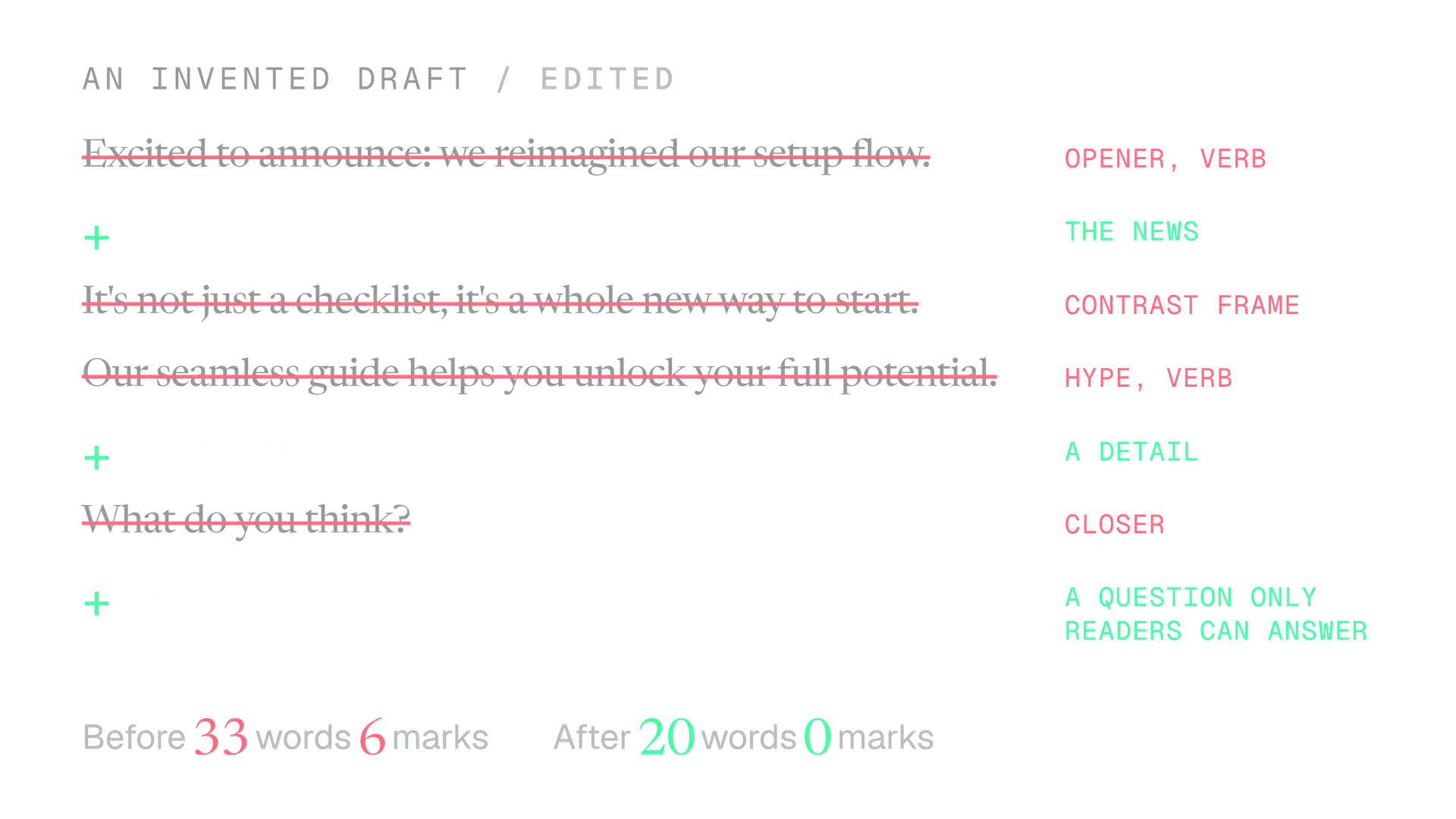
In today's fast paced world, it's no secret that onboarding matters. Let's dive in.
Three sentences, no information. The reader has learned nothing about your product.
Opens with the news (an invented example)
Setup used to take six steps. It now takes three.
The news is the first sentence, and a number gives the reader something to check.
First lines get their own guide: how to write X hooks covers seven structures and the rewrites that go with them.
Inflated verbs to swap for plain ones
Swap the big verb for the small one: use, show, help, improve. Then ask how. The big verb is usually standing in for a fact you have not given yet.
Verbs are where the research is clearest. In the 2025 study, delves was used about 28 times more than the trend predicted, underscores about 14 times and showcasing about 11 times. Words as ordinary as crucial rose too.
| Tell | Plainer choice |
|---|---|
delve | look at, dig into, explain |
leverage, utilize | use (the Federal Register's clear writing guide gives use for utilize) |
unlock, unleash | get, start, lets you do something specific |
elevate, supercharge | improve, speed up, and say by how much |
empower | let, help |
streamline | simplify, or cut three steps and say so |
showcase, underscore | show |
foster | build, encourage |
craft | write, make |
Swapping the verb is half the job. Streamline how? Elevate by how much? Answer the question and the sentence earns its place.
Hype words that claim instead of show
Hype words declare an impact the reader cannot check. Replace each one with the fact it stands for, and if there is no fact, cut the sentence.
- Claims no one can check.
World class,best in class,unparalleled. Name the standard or the customer instead. - Intensity with no unit.
Game changer,groundbreaking,mind blowing. Show the before and after. - Mood words.
Vibrant,tapestry,realm. Describe what you actually saw.
Wikipedia's field guide lists crucial, pivotal and vibrant among the words that AI text overuses. The 2025 study found crucial used well beyond the trend. For tapestry and realm we know of no study measuring a rise, so we make no claim about them. They are on our checker's list because they almost never fit a post about work.
A claim
A seamless, robust platform that is a game changer for modern teams.
Three adjectives and no feature. Nothing in the sentence can be pictured or checked.
The fact behind it (an invented example)
It imports your content calendar as a file and keeps your posting times.
One verb, one object, one detail. A reader can tell whether it matters to them.
Hedges and padding that dilute the point
Our checker puts it well: one hedge is caution, three is fog. Keep a hedge only when you really are unsure, and say what you are unsure about.
Most hedges we see are not doubt, though. They are habit, and they spend characters. The Federal Register's clear writing guide gives the same swaps: in many cases becomes often, and because of the fact that becomes since or because.
| Padded | Plain |
|---|---|
| Due to the fact that the form is long, users leave. | Users leave because the form is long. |
| In many cases, the form is too long. | The form is often too long. |
| It's worth noting that links count as 23 characters. | Links count as 23 characters. |
| A wide range of tools can help. | A spreadsheet or a calendar app can help. |
The third row is a real rule from X's developer documentation. Notice that the plain version is not only shorter. It reads as more certain, because the writer stopped asking permission to say it.
Cliché closers and engagement bait
End on the last useful sentence. If you want replies, ask a question only your readers can answer, or ask nothing.
Closers are easy to copy. What do you think? could follow a post about anything, so it gives no one a reason to answer this post in particular. A specific question gives people something to answer.
What do you think?becomes a choice:Which would you pick, A or B?Follow for moreneeds a reason: say what you post and when.Let me know in the commentsbecomes the actual question.Let that sink inandFood for thoughtcan simply go.Stay tunedneeds a date, or nothing.
Two ways to preview a post before it goes out: phone view or desktop view.
Which do you check first?
Sentence shapes that give a draft away
Some tells are shapes, not words. Each is fine once. Used by habit, they are a common sign of a template, because a reader sees the same frame in post after post.
- The contrast frame.
It's not just a checklist, it's a whole new way to start.State the second half directly: what the checklist does. - The two step reveal.
Not just X, but Y. Lead with the more important half. - The self answered question.
The result?Merge the answer into the sentence. - The pointer.
Here's why:Cut it and start the explanation. - The label.
Spoiler:,Pro tip:,Hot take:. Let the sentence stand alone. - The slogan.
No X. No Y. Just Z.Say what it does. - The stage direction.
Read that again,Let me explain. Cut it and explain.
Three more are visual: the spool and pointing finger markers at the end of a thread opener, stacks of rocket and fire emoji, and two em dashes wrapped around an aside. The checker flags all three. Wikipedia's guide lists heavy em dash use too, and plenty of careful writers use them, so decide for your own voice. A comma, a bracket or a full stop does the same job.
When a flagged word is fine to keep
Keep a word when you mean it and no plainer word is as exact. A checker finds patterns, not meaning, so the last decision is yours.
The same word can be filler in one place and exact in another. Robust in a launch post claims nothing. In a test report it can describe how a result held up under changed conditions. Three questions sort most flagged words: did you mean it, is there a plainer word, does the sentence need it.
Technical words that are not filler
Some flagged words are real terms in a field. Leverage has a precise meaning in finance, and robust in statistics. If your readers use the word that way, keep it. If you are only using it to sound serious, swap it.
A quick test: would a colleague in your field say it aloud, to another colleague, without smiling? If yes, keep it.
How to edit a draft for AI words in ten minutes
Edit in a fixed order so you do not rewrite the whole post. Start at the edges, then work through the marks.
Read the first and last line
Cut any opener or closer from the lists above. Start on the point and end on the last useful sentence.
Run the checker
Paste the draft into the AI phrase checker. It runs in your browser, so nothing is uploaded.
Decide on each mark
Keep, swap or cut. Swap when a plain twin exists. Cut when the sentence works without it.
Add one detail where you cut a claim
A number, a name, a before and after. Only add what is true, and say it the way you would say it to a colleague.
Read it aloud
If you would not say a line, change it. Then check the length in the character counter.
If you draft with an AI model, put your never list in the brief. In Kairo Post, each account keeps its own list of phrases to avoid, and AI drafts follow it. You can see how that fits together on the Brand brain page.
Mistakes we see when people try to sound human
The most common mistake is fixing the word and keeping the empty claim. Delve into becomes dive deep into, and the sentence says the same nothing in a fresh coat of paint. Wikipedia's editors make the same point about their own list: do not merely treat the signs as problems to be fixed, because that can just make detection harder.
- Adding typos or slang to fake a voice. It reads as fake, and it makes the post harder to read. Write the way the account really sounds.
- Chasing zero marks. A draft with no marks can still be vague. The marks per 100 words figure in the checker is for comparing two drafts of the same post, not for grading quality.
- Banning words, not habits. If
leverageis blocked andharnessappears, the habit is the problem. Block the pattern, then add the detail. - Accusing someone. A mark is a prompt to reread. It is not a finding about the writer.
If you write for a brand, turn the marks you keep catching into a short never list for that account. We cover how a voice sheet works in our guide to managing X for clients.
Before your next post: a checklist
Run this on the next draft. It takes about two minutes once you have done it a few times.
Before you post
- The first line is the point, or the news, and not a sign that a point is coming.
- No big verb sits where a small one would do.
- Every hype word is replaced by the fact behind it.
- Each hedge stays only where you are truly unsure.
- The last line is useful, a question only your readers can answer, or nothing.
- No sentence shape appears more than once.
- You have read it aloud and would say every line.
Paste the draft into the AI phrase checker for a second pair of eyes, then decide mark by mark. When the first line still feels weak, grade it with the hook grader. A thread needs the same pass on every post, and how to write an X thread shows where each one does its job.
In the product
How Kairo Post does this
Everything above works by hand. Kairo Post does the same work for you, with your approval before anything goes out.
Questions people ask
Can you tell if a post was written by AI from the words alone?
Why do chatbots use words like delve so much?
Is the em dash a sign of AI writing?
Is it wrong to use a word like leverage or robust?
Should I run a post through an AI detector before I publish it?
How do I stop an AI model writing with these words?
Sources
Every rule, limit and figure in this post was checked against these on the date shown.
- Delving into LLM-assisted writing in biomedical publications through excess vocabulary, Science Advances
pmc.ncbi.nlm.nih.gov · checked
- Why Does ChatGPT Delve So Much? Juzek and Ward, arXiv
arxiv.org · checked
- GPT detectors are biased against non native English writers, Patterns
pmc.ncbi.nlm.nih.gov · checked
- OpenAI Shuts Down Flawed AI Detector, Search Engine Journal
searchenginejournal.com · checked
- Wikipedia:Signs of AI writing, WikiProject AI Cleanup
en.wikipedia.org · checked
- Principles of Clear Writing, Office of the Federal Register
archives.gov · checked
- First 2 Words: A Signal for the Scanning Eye, Nielsen Norman Group
nngroup.com · checked
- Counting Characters, X developer documentation
docs.x.com · checked
Written by