Best time to post on X: find the hours that fit your audience

The short answer
There is no single best time to post on X. Your best hours are when most of your followers are awake and on X, so work out where they live, find the overlap on one clock, and test two or three windows against your own results.
Key takeaways
- Four published guides name four different best times, and no hour appears in all four. Use them as a first guess at most.
- Start from where your followers live. Put each place on one clock, weight it by its share of your audience, and read off the overlap.
- In the Following feed the newest posts come first. In For You, X's published code drops posts older than 48 hours before ranking.
- Test two or three windows over two weeks, compare the median engagement rate per impression, and change your default only when a gap holds.
- Clocks change on different dates in the US and Europe. Recheck your slots after every change.
You want your posts to land when your followers can see them. So you search for the best time to post on X and find a confident answer, usually a day and an hour, from a site that has never seen your followers. The trouble is that the confident answers do not agree with each other.
This guide gives you a method instead. You will see why the published best times clash, what X itself says about timing, and how to work out the hours that suit your audience from where your followers live. Then you test those hours, so the answer comes from your own posts and not from someone else's average.
Why every best time to post on X list gives a different answer
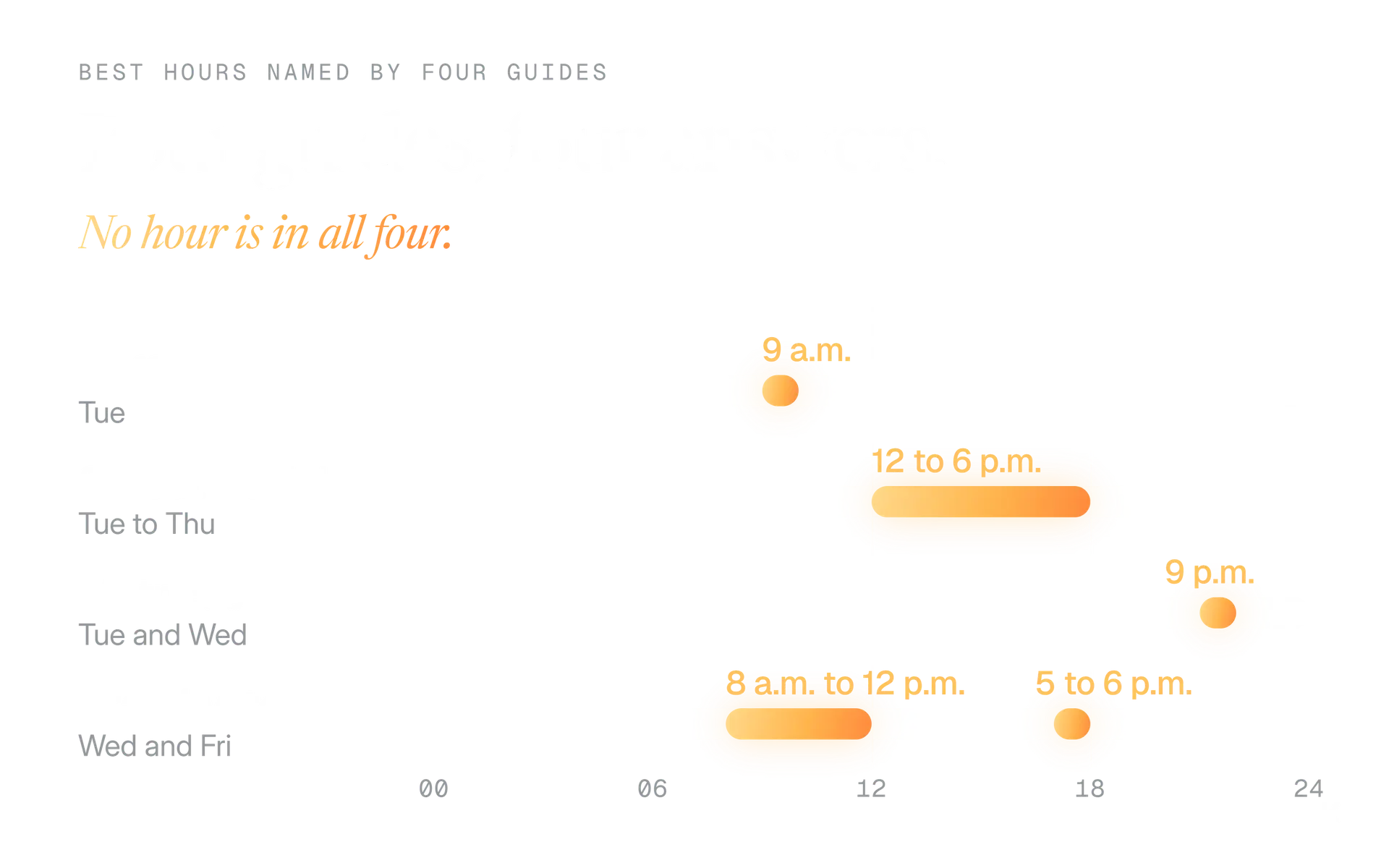
Each list measures a different crowd, on a different clock. Four published guides give four different answers, and no hour of the day appears in all four. Clock changes can move your slots by an hour; see daylight saving time and scheduled posts.
| Guide | Best time it names | Based on |
|---|---|---|
| Buffer | 9 a.m. on Tuesday | More than 8 million posts |
| Sprout Social | 12 to 6 p.m. on Tuesdays, Wednesdays and Thursdays | Nearly 2 billion engagements on six networks |
| Metricool | 9 p.m., with Tuesday and Wednesday the strongest days | More than 2 million posts |
| Brandwatch | 8 a.m. to 12 p.m. and 5 to 6 p.m. on Wednesdays and Fridays | No sample size given |
That is not dishonest. Each study can be right about its own pool of accounts and still be wrong for yours. Three differences show on the pages themselves:
- Different crowds. Sprout's number comes from about 307,000 profiles on six networks. Buffer's and Metricool's come from their own pools of posts. An average over many audiences describes none of them.
- Different clocks. Buffer and Sprout tell you to read their times as local time. Metricool and Brandwatch do not say. But local to whom? If your followers live in three countries, no clock is local to all of them.
- Different yardsticks. Sprout's sample is engagements. We could not find the measure stated plainly on every page, so you cannot tell whether a best hour means the most reactions or the best result for each post.
The studies do agree on two things:
- Weekends are weaker on average. Buffer calls Saturday the quietest day, Metricool says to avoid Sundays, and Sprout finds Sunday the lowest performing day across the networks it studied.
- You should test on your own account. Sprout calls its numbers a baseline, and Buffer calls post timing likely one small piece of a pretty complex puzzle.
So use a published list as a first guess if you have no history. Then replace it with your own.
What X says about timing, and what it does not
X does not publish a best time to post. What it publishes is how its two main feeds work, and that explains why the hour matters at all.
The Following feed shows posts only from accounts you follow, in reverse chronological order. That is a queue: newest first. When a follower opens X, your post sits near the top only if you posted recently compared with everything else they follow.
The For You feed works differently. X says it narrows roughly 500 million posts made each day down to a handful, looks for recent and relevant content, and ranks relevance with a neural network trained on each person's interactions, such as Likes, Reposts and Replies.
X also publishes the code behind For You. It lists a filter that removes posts older than 48 hours before anything is ranked, and another that skips posts the viewer has already been shown. So in For You a post has two days at most to be recommended.
That is still worth getting right, because it is one of the few levers that costs nothing.
How to find the best time to post on X for your audience
Work from where your followers live, not from a list of hours. All you need is a pen and a rough idea of where your people are.
Find where your followers live
Start with what your own analytics on X shows about your audience. Then cross check it with where your website visitors from X are, where your customers or subscribers live, and where the people who reply to you seem to be. A rough split is enough: "about half US East Coast, a third UK, the rest Gulf". Profile locations are free text, so treat them as a hint.
Give each place a share
Write each place with the share of your audience it holds, and make the shares add up to 100. Round to the nearest 10. You do not have more precision than that, and the method does not need it.
Mark when those people are awake
Assume 7 a.m. to 11 p.m. local time unless you know better. If people follow you for work, use their working hours. If they follow you for a hobby, include evenings and weekends. You know your audience better than any study does.
Put everyone on your clock and add up the shares
Shift each place's awake hours to your own time zone, then add up, hour by hour, the share of your audience that is awake. The tallest stretch is your overlap.
Here is the whole thing on an example audience. The numbers are made up, and your clock is London time in an ordinary summer week. Half your followers are in New York, 30% in London and 20% in Dubai. On the London clock, New York is awake from 12:00 to 04:00 the next day, London from 07:00 to 23:00, and Dubai from 04:00 to 20:00.
| London time | Share awake | Why |
|---|---|---|
| 12:00 to 20:00 | 100% | All three groups are up |
| 20:00 to 23:00 | 80% | Dubai has gone to bed |
| 05:00 | 20% | Only Dubai is up |
Awake is the floor, not the target. At 12:00 in London it is only 7 a.m. in New York, so the overlap includes people who have just got up. Pick two or three candidate slots inside it, spread across the window: say 13:00, 16:00 and 19:00 London time. The test below tells you which of them your people really use.
Our free planner does the shifting and adding for you, with the real offsets for today's date. You enter the cities and shares, and it shows the overlap on your own clock.
What to do with your audience shape
The overlap decides your plan, and audiences come in four shapes. Find yours below.
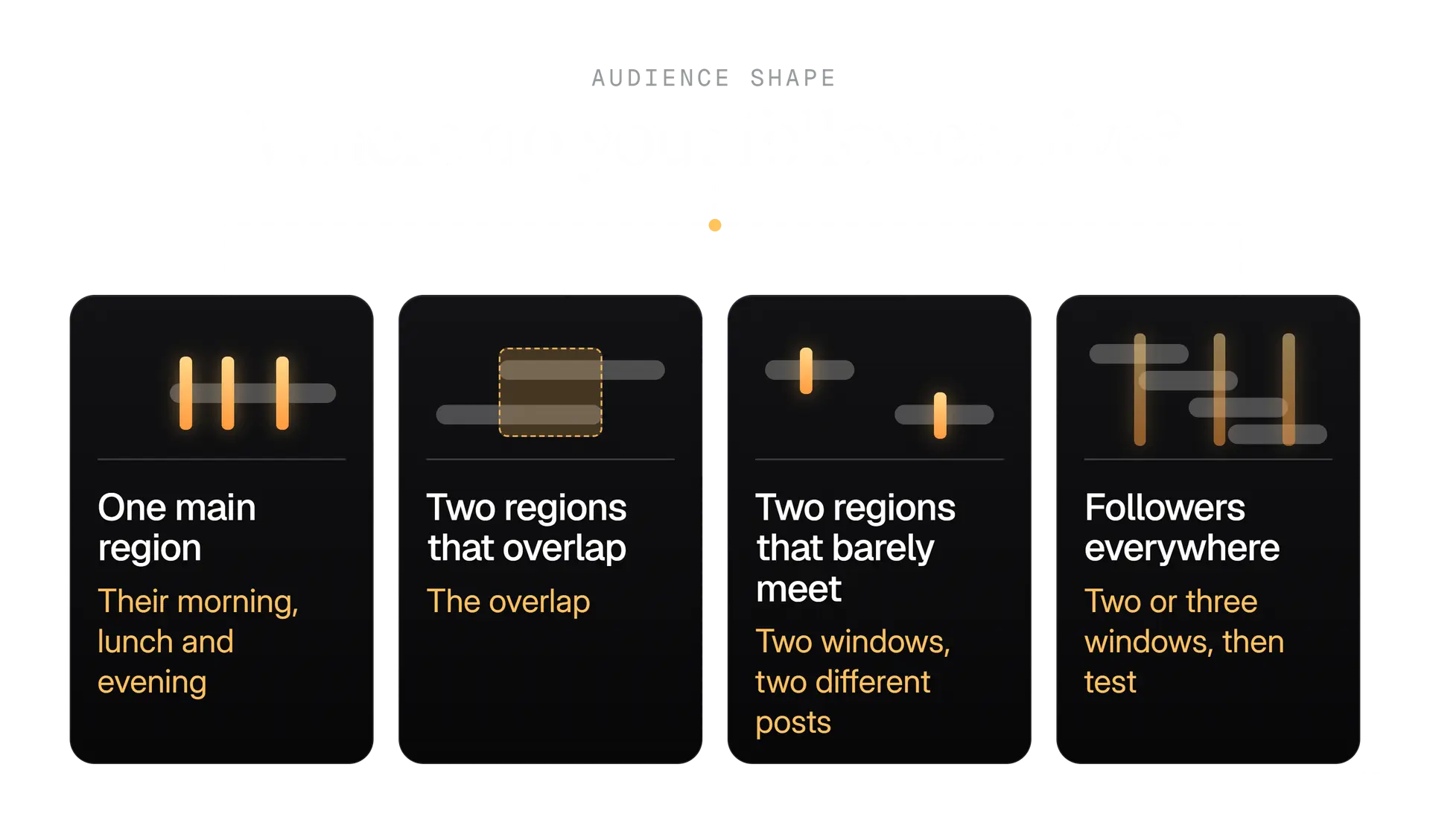
- One main region. Most followers sit within a couple of time zones. Choose their morning, lunch and evening, and test those three.
- Two regions that overlap. Many accounts are like this, such as a mix of Europe and the US East Coast. Use the overlap, as in the example above, and put your candidates at its start, middle and end.
- Two regions that barely meet. Their useful hours hardly overlap, which happens when you narrow each group to its working day and the two sit far apart. No single slot reaches both well, so use two windows and write a different post for each.
- Followers everywhere. Then the overlap strip is flat and no hour wins. Use two or three windows across the day and let the test show which ones pay.
What to do if you have few followers or no data yet
A small account has no pattern to read yet. With a few dozen followers, one person being online or offline changes the whole picture. So start from the audience you want, not the audience you have.
- Plan for the audience you want. Write down who you are trying to reach and where they live: the cities of your customers, your launch market, or the community you are joining.
- Use a published list only to start. Let it choose your very first slots, and stop leaning on it once you have ten posts of your own.
- Read the test loosely. Run the same two week test described below. With small numbers, a handful of impressions moves a rate a long way, so compare impressions as well as rates, and trust only a gap that is large and shows up in both weeks.
Do not let timing hold up the writing. A post you publish at an average hour teaches you more than a draft you are still polishing while you wait for a perfect one.
Time zones and clock changes that quietly move your best time
Clocks change on different dates in different places, so the gap between two audiences moves, and your best time moves with it.
The US moves its clocks forward on the second Sunday in March and back on the first Sunday in November, and Hawaii and most of Arizona stay on standard time. The UK and the EU move on the last Sunday of March and the last Sunday of October.
| Place | Clocks forward | Clocks back |
|---|---|---|
| United States (except Hawaii and most of Arizona) | Second Sunday in March, 8 March 2026 | First Sunday in November, 1 November 2026 |
| United Kingdom and the EU | Last Sunday in March, 29 March 2026 | Last Sunday in October, 25 October 2026 |
Look at what happens in between. In 2026 the US moves on 8 March and the UK on 29 March. For those three weeks, New York is 4 hours behind London, not the usual 5. In autumn the order flips: the UK moves back on 25 October and the US on 1 November, so the gap is 4 hours again for one week.
Two habits keep you safe. First, decide whose clock each slot belongs to. If a slot exists for New York's 8 a.m., set it on New York's clock, or recheck it after each change. A slot saved as a fixed time on another clock lands an hour early or late for that audience for part of the year.
Second, put the four change dates in your calendar. The next gap week this year runs from 25 October to 1 November. If your audience is split across the Atlantic, look at your slots that week and do not read too much into its results.
How to test your best posting times without fooling yourself
A test turns your candidate slots into an answer. The aim is simple: change one thing, the time, and keep everything else steady.
To read the results, X's Post Activity Dashboard shows the last 28 days by default, and a CSV export covers up to 30 days and 3,000 posts at a time. The export's times are in UTC, so convert them to your own clock before you compare slots.
Pick three candidate slots
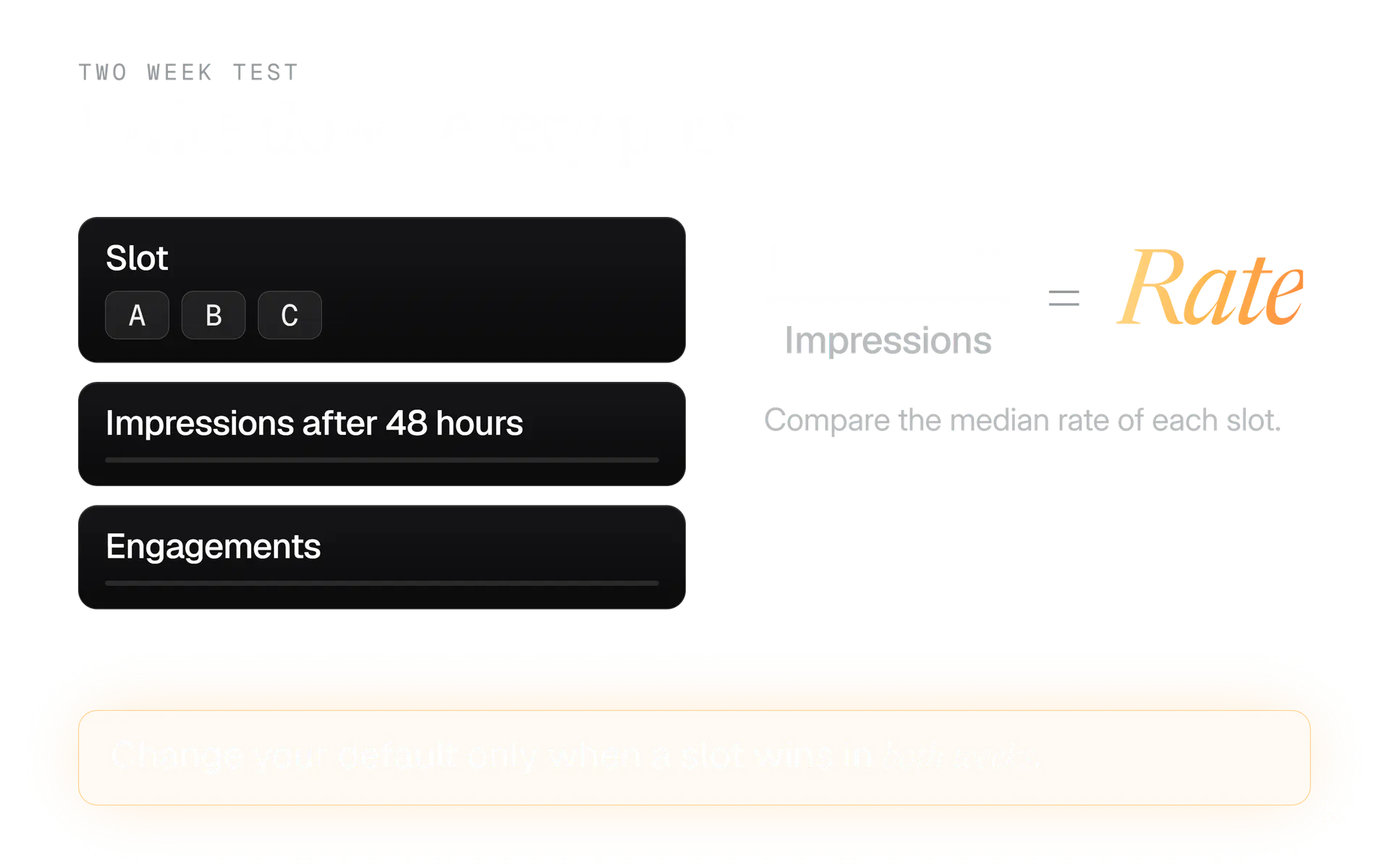
Take them from your overlap, as in the example: an early, a middle and a late slot. Call them A, B and C.
Rotate them across ten weekdays
Post at A, B and C in turn over two weeks, so no slot always gets Monday or Friday. Keep the kind of post, the length and the media steady. If slot B gets all your images, you are testing images.
Wait before you read the numbers
Give each post 48 hours first, and use the same wait for every post. We pick 48 hours because that is how long X's published code keeps a post eligible for For You.
Write every post down
Note the slot, the impressions, the engagements and the rate. Our engagement rate is engagements divided by impressions, which you can work out with the engagement rate calculator. Do it as you go. X's developer documentation says private and organic metrics for your own posts reach back only 30 days through the API, so do not leave it all to the end.
Compare the middle of each slot, not the best post
Line up the median rate for A, B and C. The median is the middle post when you sort them, so one lucky post cannot drag it.
Why the median? One post can go well for reasons that have nothing to do with the hour. A reply from a large account, a news story or a good image can do it. The picture below shows how a single outlier lifts an average and leaves the median alone. The numbers in it are made up.
Ten posts is a small sample. So the rule is strict: a slot becomes your new default only if it wins in both weeks. If the gap shrinks in week two, keep the old default and test something else.
Mistakes we see with posting times
These come up so often that we check for them first.
- Copying a list of hours. The list describes someone else's followers. Start from yours.
- Saving a slot on the wrong clock. A slot that was right in March can be an hour out in April. Decide whose clock it belongs to.
- Changing everything after one good post. Wait for a gap that holds in both weeks.
- Testing the time and the content together. If the best slot also got your best idea, you have learned nothing about time.
- Posting when nobody can reply. A post that starts a conversation at 3 a.m. gets its replies read at 9 a.m. Schedule when someone can answer.
- Treating weekends as a rule. On average they are weaker, as three studies say. Your followers may not be average, so give one weekend slot one test.
Notice that none of these needs a special tool. They need a plan before you post and a pattern to look at after.
Your plan for this week
You can do this in an afternoon. Here is the order.
- Write down where your followers live and a share for each place.
- Find your overlap, by hand or with the best time to post planner, and pick three slots inside it.
- Plan ten posts of one kind across the next ten weekdays. The content calendar generator helps with the ideas.
- Schedule them so each slot gets an even share of the days. Analytics in Kairo Post shows each account's best hours from the engagement of its own posts, in your time zone, and scheduling keeps posts to those hours.
- After two weeks, compare the median engagement rate per slot. Keep a winner that held in both weeks as your default. Keep rotating a third slot so you keep learning.
- Put the next clock change dates in your calendar.
If a published list happens to agree with your result, good. If it does not, trust your own posts.
In the product
How Kairo Post does this
Everything above works by hand. Kairo Post does the same work for you, with your approval before anything goes out.
Questions people ask
Does the time you post on X really matter?
How long does a post stay in people's feeds on X?
Is it better to post on X in the morning or the evening?
What is the best time to post on X if my followers are in different countries?
What is the best time to post on X at weekends?
Do clock changes affect the best time to post on X?
Should I post at the same time every day?
Where can I see when my followers are online?
Sources
Every rule, limit and figure in this post was checked against these on the date shown.
- Post and Video Activity Dashboards, X Business Help
business.x.com · checked
- For You Home Timeline Recommendations, X Help Center
help.x.com · checked
- About your For you timeline on X, X Help Center
help.x.com · checked
- README of the For You feed code, X on GitHub
github.com · checked
- Authenticity, X Help Center
help.x.com · checked
- Metrics, X developer documentation
docs.x.com · checked
- Daylight Saving Time, U.S. Naval Observatory
aa.usno.navy.mil · checked
- When do the clocks change, GOV.UK
gov.uk · checked
- Summertime, European Commission
transport.ec.europa.eu · checked
- The Best Time to Post on Social Media in 2026, Buffer
buffer.com · checked
- Best Times to Post on Social Media 2026, Sprout Social
sproutsocial.com · checked
- Best Time to Post on Social Media in 2026, Metricool
metricool.com · checked
- Best Time to Post on X, Brandwatch
brandwatch.com · checked
Written by