How to grow on X: the complete guide

The short answer
Growing on X comes from five habits you control: a profile that turns visitors into followers, posts with a clear first line, replies that add something, a rhythm you can keep and a monthly review. Skip anything that buys or swaps followers, because X's rules ban it.
Key takeaways
- Growth has four gates: someone sees you, opens your profile, follows and comes back. The narrowest gate sets the pace, so fix that one first.
- X's own advice is to take part: engage with people, follow accounts you find interesting and post good information.
- A rhythm you keep for 90 days beats a burst you drop. Start with about half of what feels possible.
- Judge growth with your own ratios, such as follows per profile visit and engagement per impression, over equal periods.
- Buying followers, follow trains, repost swaps and follow churn are all against X's rules. They also add people who will never read you.
You posted for a few weeks. A handful of people liked it, mostly people you already know, and now you want to know what to change. Every guide you open says something different, and most of them promise a number. When growth stalls, our guide to an X growth plateau shows how to find the cause, and what to do after a viral post covers the days after a spike.
Here is how to grow on X in one sentence: make it easy for a stranger to follow you, give them a reason to stay, and never use a shortcut that X bans. This guide is the hub for our growth cluster. Each section is the short, practical version of one lever, with a link to the full guide where we have written one.
How do you grow on X? The five levers
You grow on X by doing five things well and skipping the shortcuts. The five are a profile that converts visitors, posts worth reading, replies that add something, a rhythm you can keep and a review that tells you what to repeat. Growth is easier when people know what you stand for; our personal brand guide shows how to set that up.
X's own Help Center gives the same shape of advice on its account behaviour page: take part. Engage with people, follow accounts whose posts interest you, and be active by reading and posting good information. Two places to meet people in your niche: X Communities and Spaces. Three more growth routes: collaborating with other accounts, using X Lists and growing in a language other than English.
| Lever | The question it answers for a stranger | Where to go deeper |
|---|---|---|
| Profile | Should I follow this account? | X profile optimization |
| Posts | Is this worth my next minute? | X hooks, threads |
| Replies | Who is this person, and are they worth knowing? | The replies section below |
| Rhythm | Will this account still be here next month? | Best time to post, scheduling |
| Review | What should I repeat? | Engagement rate, click tracking |
Think of growth as a path with four gates. Someone has to see a post of yours, open your profile, follow, and then see something worth coming back for. Three more growth guides: why bought followers and engagement pods backfire, why founder accounts outgrow brand accounts and growth myths that waste your time.
The weakest gate sets the pace. A brilliant post that lands on a blank profile loses the visitor at gate three. A polished profile with nothing worth reading in the feed loses them at gate four. Posting more only widens the first gate.
Start with your profile: the page every new visitor lands on
Your profile is where gates two and three happen, so it comes first. A visitor reads your photo and name, then your bio, then your pinned post, and decides in a few seconds. Every field has one job.
Our X profile optimization guide goes field by field. Here is the five minute version.
Five minute profile check
- The name and bio say who you are and what you post, in words a stranger understands.
- The photo is still recognisable when it is small. Sizes are in our X image sizes guide.
- One pinned post shows what following you gets.
- The link goes to the one place your bio points at.
- The account is public, if you want strangers to be able to follow.
Run your bio and name through our free X bio checker before you save, because it counts each field against X's limits.
Then leave the profile alone for a few weeks. We change one thing at a time, so that a change in follows can be tied to the edit that caused it.
Choose what you post and who it is for
Before you write a post, write one sentence: "I post about ___ for ___ so they can ___." Every idea you have can be held against it. If an idea does not fit, it is a different account's post, not yours.
From that sentence, pick three to five content pillars. A pillar is a theme you could write ten posts about today and that someone you want to reach cares about.
Here is how the same pillars look for a made up account that teaches bookkeeping to freelancers. The names are an example, not a template to copy.
Pillar one
Teach
One small skill per post. "How to check an invoice before you send it."
Pillar two
Show the work
What you actually did this week, with the mistakes left in.
Pillar three
Take a view
A position on how your field does something, with the reason.
Pillar four
Answer a question
A real question a reader asked, answered in public.
Our free content calendar generator turns your pillars and rhythm into a month of slots you can download. It does not write the posts, which is the right division of labour.
Write posts people read to the end
A post that earns attention does three things: it tells the right reader it is for them, it gives one specific detail to believe, and it stops when the idea is done. The first line carries most of that weight.
Our guide to X hooks covers seven first line structures with weak and strong examples. Pair it with the free hook grader to check a line before you post.
A first line that earns the second
I rewrote our late payment email three times. The shortest version got paid fastest.
A first line that clears its throat
Some thoughts on getting paid on time, a quick note.
Both examples are made up. The first names a detail and promises a payoff. The second could open any post by anyone.
A short routine keeps drafts moving.
Pick one idea
If you cannot say it in a sentence, it is two posts.
Write the line a stranger would stop on
Put the number, name or turn in the first few words. Cut the warm up.
Cut the words that sound like everyone
Our list of AI words to avoid shows the fillers and stock phrases that make a draft read as machine made.
Count it the way X counts
Links and emoji weigh more than they look. How X counts characters has the rules.
280
characters in a standard post
X Developer Platform, Counting Characters
23
characters for any link
X Developer Platform, Counting Characters
2
characters for each emoji
X Developer Platform, Counting Characters
One caution on styling. Bold and italic letters in posts are special Unicode characters, not real formatting. Our bold and italic text guide shows how a screen reader reads them and when they are worth using.
When a thread beats a single post
Write a thread when one idea needs steps, proof or a story, and write a single post when the idea fits in one breath. A thread is a way to hold a reader for longer, not a way to make a thin idea look bigger.
| A single post | A thread |
|---|---|
| One idea you can finish in a sentence | One idea that needs steps, proof or a story |
| Quick to write and easy to repeat | Takes an hour to do well |
| The first line is the whole pitch | The first post must work alone, then earn the second |
| Good for a view, a question or a result | Good for a how to, a breakdown or a lesson |
If you are not sure, write the single post first. When readers ask for more, that post is your first post in a thread. Our full guide covers how to write an X thread, including how long it should be and how to proof it before you press Post all.
Add images without slowing yourself down
An image is worth the minutes it costs when it explains something the words cannot, or when it makes a long line scannable. Otherwise, post the words. Pictures added out of habit take time and give a reader nothing.
Two jobs justify the effort.
- A quote card. One line, in large type, with credit. Our guide to X quote cards covers attribution, contrast and the image description, and the free quote card maker builds one in your browser.
- A diagram or screenshot. Something that would take a paragraph to describe. Check the shape against our X image sizes guide so nothing is cropped.
Every image should carry an image description for people who cannot see it. Our guide to alt text on X covers it in full. The short version: say what the picture shows and repeat any words that sit inside it.
Replies: how strangers find out you exist
Replies are how strangers meet you before you have an audience. A post reaches the people who already follow you, plus whoever X chooses to show it to. A good reply sits in front of the audience of the post you answered.
That is why a short daily reply session often does more for a small account than another post. But only a reply that adds something works. A reply that takes, such as "great post" or a link to your own page, tells the reader nothing about you.
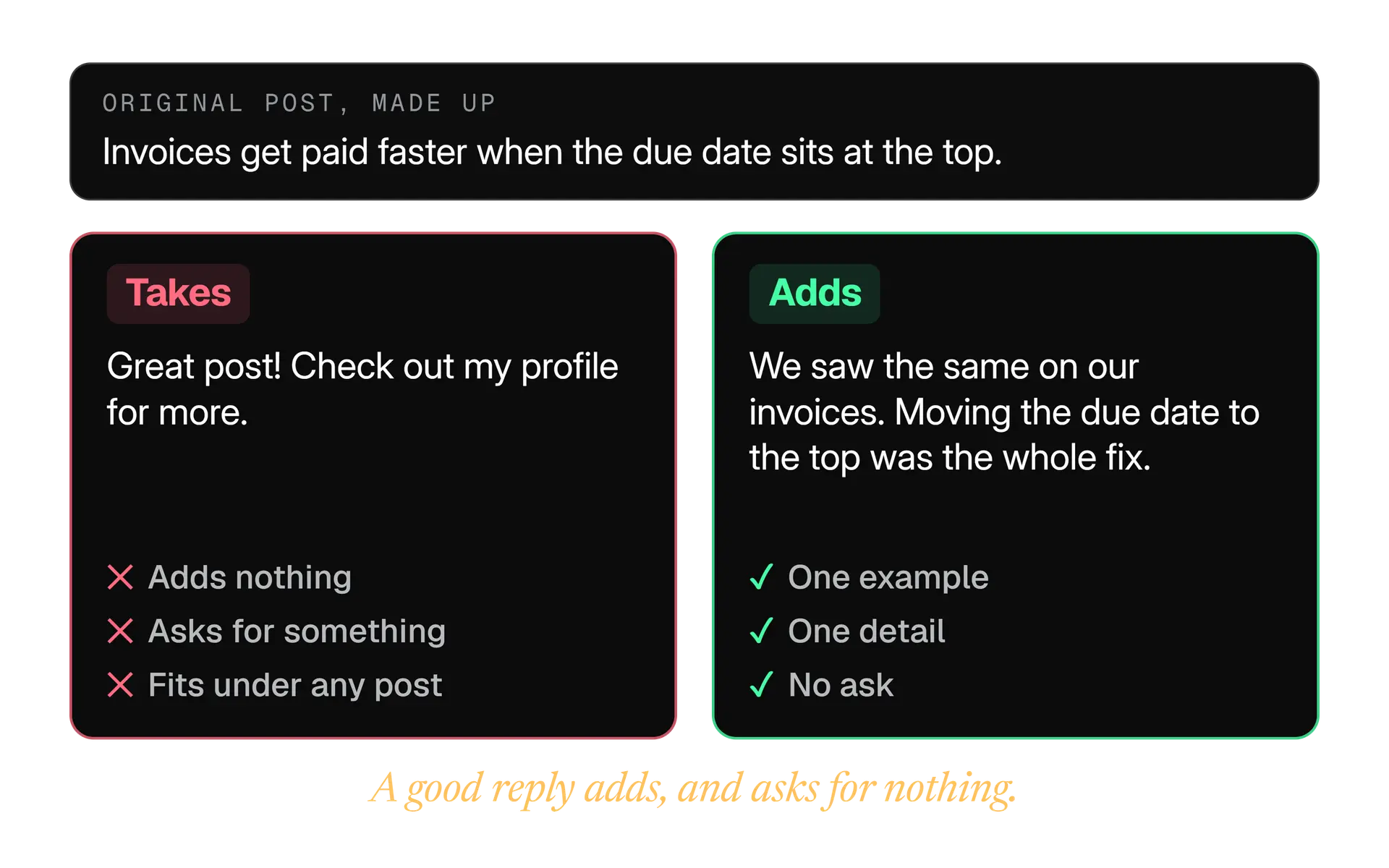
A 15 minute reply session needs no special tools.
Open the posts from your niche
Use accounts you already follow. Look at the last day or so of what they posted.
Pick posts where you know something
If you have nothing to add, skip it. A skipped post costs nothing and a weak reply costs trust.
Add one thing
An example, a question that moves the conversation on, or a correction with its source. Keep it short.
Never paste the same reply twice
Each reply is written for its post. X's rules say you may not post content in a bulk, duplicative, irrelevant or unsolicited manner.
Our guide to growing with replies covers whose posts to answer and a daily routine. Remember that X's rules do not allow bulk, aggressive or automated following, and they limit automated replies. Our X automation rules guide has the detail, and what X does with duplicate posts explains why a copied reply is a problem.
How often and when should you post on X
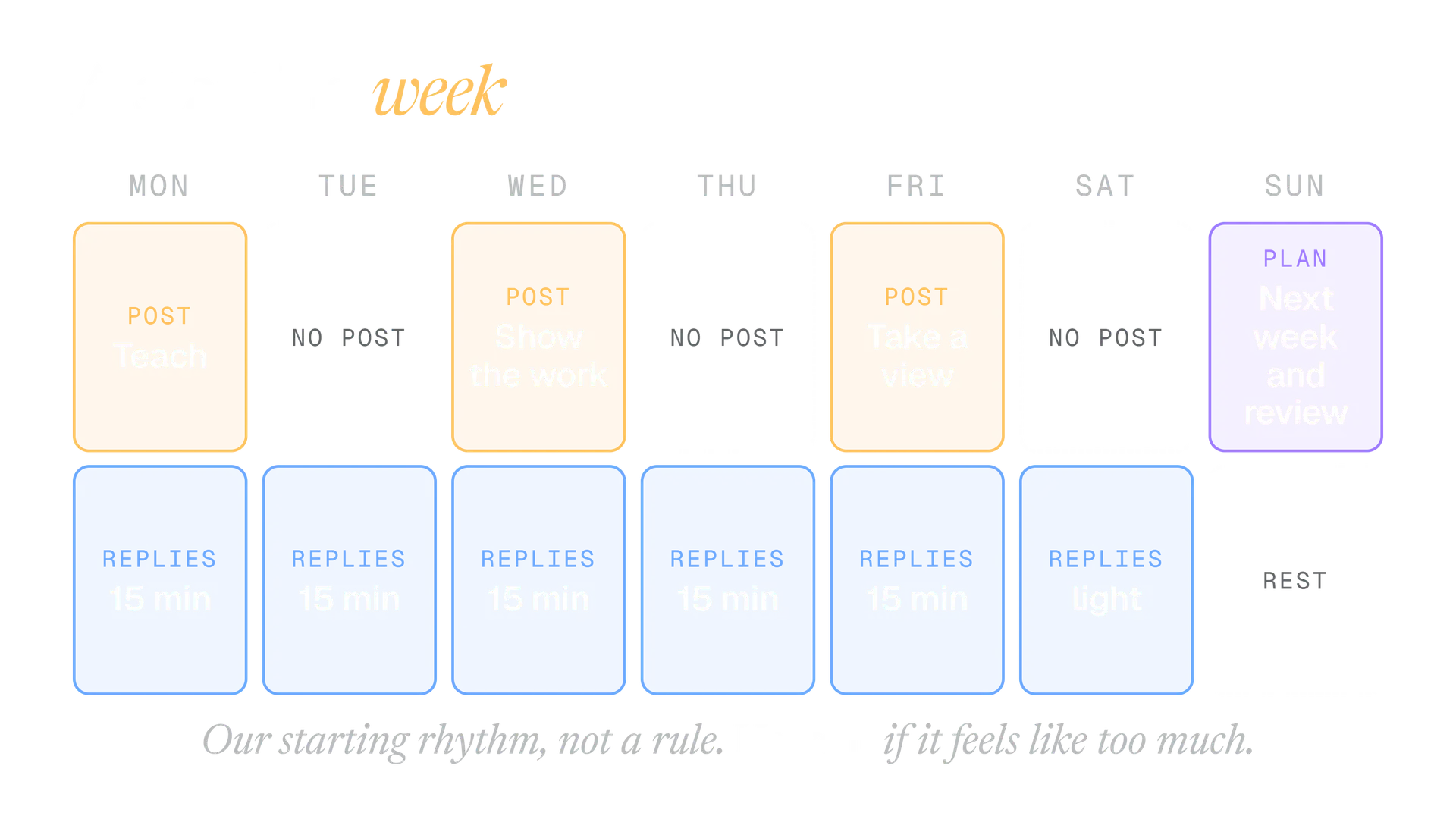
Post as often as you can keep up for three months, and no more. For most people that is a few posts a week plus a short daily reply session. A rhythm you keep beats a burst you drop, because readers need time to trust an account that is reliably there.
The two lanes show an example, not a study. The sprint posts twice a day for 2 weeks and stops. The steady lane posts 3 times a week for 8 weeks. The sprint has more posts at week 2. By week 8 only one account is still posting.
This table is a starting point, not a rule. Pick the row that matches the time you really have.
| Time you have | A rhythm to start with |
|---|---|
| 15 minutes a day | 2 posts a week and a 10 minute reply session on 5 days |
| 30 minutes a day | 3 posts a week, 1 thread or image a month, and a daily reply session |
| An hour a day | 4 to 5 posts a week, 1 thread a fortnight, replies and a weekly review |
For the question of timing, our best time to post on X guide shows how to find the hours your followers are awake and test them without fooling yourself. The free best time to post planner does the time zone sums.
What does X say about how posts reach people
X shows a person two kinds of posts: those from accounts they follow, and recommendations from accounts they do not. Your growth depends on the second kind reaching people. X publishes what it looks at, though not how much each signal counts.
| Following timeline | For you timeline |
|---|---|
| Posts from accounts you follow only | Posts from accounts you follow plus recommended posts |
| You reach people who already chose you | You can reach people who have never heard of you |
| Gate four: they come back | Gate one: a stranger sees you |
X's Help Center says recommendations draw on signals such as accounts and Topics a person follows, posts they like, and posts liked or accounts followed by those in their network. It also says X filters content that may be harmful, abusive or spammy before it ranks the rest.
X also publishes the code behind its For You feed. Its description lists the actions the system predicts for each post: favorite, reply, repost, quote, share, and also follow author. Alongside them sit negative actions such as not interested, mute author, block author and report.
We read that list in plain terms. Write for a reader who might reply, share or follow, and avoid anything that makes a reader want to mute or report you. The list says what X predicts, not how much each action counts, so we do not give weights here. A separate guide to how the X algorithm works will go further.
How to measure growth without fooling yourself
Measure three ratios over equal periods and compare them with your own earlier numbers. Follower count alone tells you what happened, not why. A ratio tells you which gate to fix.
The three ratios, and what each one tells you:
| Number | How to work it out | The gate it points at |
|---|---|---|
| Follow rate | New follows ÷ profile visits | Gate three, the profile |
| Engagement rate | Engagements ÷ impressions × 100 | Gate four, the posts |
| Clicks per post | Link clicks from X, by tagged link | What leaves X |
Our engagement rate guide explains the formula and why the impressions version is the one to keep. To see which posts send traffic to your site, follow how to track clicks from X.
3
non public post metrics: URL clicks, profile clicks and engagements
X Developer Platform, Metrics
30 days
how long after a post these metrics stay available through X's API
X Developer Platform, Metrics
Both figures come from X's developer documentation, which says non public metrics are only available for posts created within the last 30 days. If you want a history, save your numbers every month.
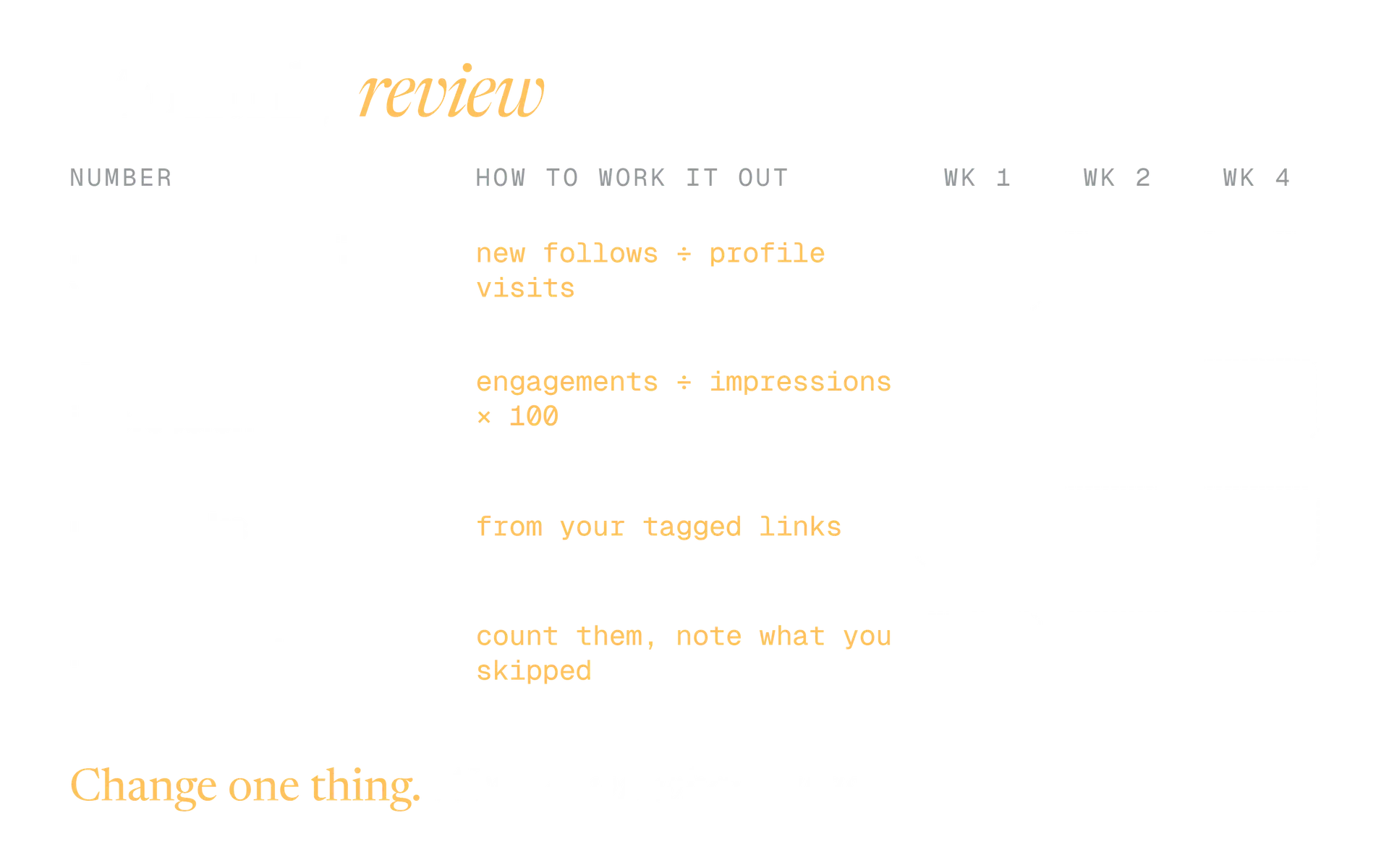
A review is only useful if it ends in a decision. Pick the weakest gate, change one thing, and write down what you changed.
What not to do: shortcuts X's rules ban
Skip every shortcut that buys, swaps or fakes attention. X's Authenticity policy bans coordinating to exchange engagement, such as likes, replies, reposts or follows, and paying others to inflate account metrics. Follow trains and repost swaps are exactly that kind of exchange.
Each banned shortcut fails for a second reason, on top of the rule.
Banned
Bought followers
Bought followers have no reason to read your posts. Your follower count rises while engagement stays put, so your engagement per follower falls.
Banned
Follow trains and repost swaps
People who follow because they were asked to have no reason to read your posts.
Banned
Follow churn
Following and unfollowing large numbers of accounts to inflate your count is named in X's rules. It costs time, and the people you follow have no reason to read you.
Warned against
Apps that promise followers
X's Help Center says these usually violate its terms and may lead to account suspension. The risk falls on your account.
Here is a made up example of how bought followers hurt your own numbers. An account has 1,000 followers and a post earns 50 engagements, a rate of 5% by followers. Add 9,000 purchased followers who never engage and the same post still earns 50. The rate by followers falls to 0.5%.
Two related mistakes are easy to make by accident. Posting near identical content again and again can limit its visibility, as we explain in our guide to X duplicate content. Automation has its own rules, covered in what you can and cannot automate on X.
Protect the account you are building
A growing account is worth protecting, because losing it loses the audience with it. Three things are worth a short look.
- Security. Two factor authentication, Password reset protect and a check of connected apps. Our guide to securing your X account covers each one.
- Checkmarks. A checkmark is a label for how an account got it, not a growth lever. Our guide to X verification badges explains blue, gold and grey.
- Community Notes. A claim without a source invites a note. How Community Notes work shows what to do if one lands on your post.
If your account is ever locked or suspended, see what to do if your X account is locked or suspended.
Growing a company or client account
A company or client account grows by the same five levers, with two extra jobs: a voice that more than one person can write, and approvals that happen before a post goes out. Both slow the first week and speed up every week after.
Write one sentence first. Before the first post, write one sentence: who the account is for and what they get. Hold every idea up against it.
Our guide to managing X for clients covers access, approvals, voice, replies and reporting for agencies. If you run one company account, the same parts apply on a smaller scale. To keep several writers sounding like one account, see how to define a brand voice for X.
One more point for brands: an account run by several people needs a written rule for who replies and who approves. Without it, replies go out late or not at all, which closes gate four.
Growth mistakes we see over and over
These are patterns we see, not statistics. Most are easy to fix once you see them.
- Posting without a sentence about who it is for. The feed becomes a mix of topics and no one knows why to follow.
- Judging a week. One quiet week tells you nothing. Compare equal periods.
- Changing everything at once. The account may improve, but nobody knows which edit did it.
- Chasing the follower count. A number you cannot link to a lever tells you nothing.
- Writing for everyone. A post meant for anyone interested in business reads as meant for no one.
- A link in every post. A feed that only points elsewhere gives a reader little reason to follow.
- Dropping the rhythm after a good week. A hit does not replace a plan.
- Reaching for a shortcut in a bad month. This is when the bans in this guide tempt people most.
Your first 30 days of growing on X
Here is a plan you can start today. It assumes a few posts a week and a short daily reply session, which you can scale up or down with the table above.
Day 1
Fix the profile and write your sentence
Run the five minute profile check. Write "I post about ___ for ___ so they can ___" and pick three to five pillars.
Days 2 to 7
Write the first batch
Draft a week of posts across your pillars. Count each one, check the first line and schedule them. Pin one post that shows what following you gets.
Weeks 2 and 3
Add the reply session
15 minutes a day. Add one thing to a post you know something about. Do not touch the profile.
Day 28 to 30
Run the review
Fill in the monthly sheet. Pick the weakest gate and change one thing for the next month.
If you want the calendar, scheduling and approvals in one place, Kairo Post schedules your posts for the hours your audience is awake. It is one way to keep the rhythm, and the free tools cover the checking steps in this guide: counting, previews, hooks, bios and tagged links.
Whichever tool you use, the first month matters least for the follower count and most for the habit. When day 30 comes, read your own numbers, change one thing, and run month two.
In the product
How Kairo Post does this
Everything above works by hand. Kairo Post does the same work for you, with your approval before anything goes out.
Questions people ask
How long does it take to grow on X?
How do I get my first 100 followers on X?
Do I need X Premium to grow?
Is it safe to buy followers on X?
Should I follow lots of people to get followed back?
How many times a day should I post on X?
Why am I not growing even though I post every day?
Sources
Every rule, limit and figure in this post was checked against these on the date shown.
- Account behavior rules and best practices, X Help Center
help.x.com · checked
- Authenticity, X Help Center
help.x.com · checked
- About your For you timeline on X, X Help Center
help.x.com · checked
- For You Home Timeline Recommendations, X Help Center
help.x.com · checked
- X For You feed algorithm, X on GitHub
github.com · checked
- Metrics, X Developer Platform
docs.x.com · checked
- Counting Characters, X Developer Platform
docs.x.com · checked
Written by