X content strategy: the complete guide
The short answer
An X content strategy is a written plan that answers six questions: what the account is for, who it is for, why anyone should follow it, what it posts, how often, and which numbers you will read. Put the answers on one page, run them for a month, then review.
Key takeaways
- A strategy is a handful of answers on one page: goal, reader, position, pillars and formats, rhythm and the numbers you will read.
- Choose one goal per quarter. The goal decides which number matters, so a new goal means a new report.
- Three to five pillars and a rhythm you can keep for three months beat a bigger plan you drop.
- In X's published code, the For You feed drops posts older than 48 hours before ranking, so give a good idea a new angle later instead of an exact repeat.
- X's API keeps non public metrics for posts from the last 30 days, so save your numbers every month before you review.
You post on X, or you are about to start, and every post feels like a new decision. What to say, in which format, how often, and how to tell whether it worked. An X content strategy takes those decisions off your plate by making them once. Three tools for the plan: an audience persona worksheet, a content audit and recurring content series.
In plain terms, an X content strategy is a one page plan: what the account is for, who it is for, why anyone should follow it, what it posts, how often, and which numbers you will read. This guide is the hub of our strategy cluster. Each section gives you one decision to make and a link to the full guide where we have written one.
What is an X content strategy, and how is it different from a calendar?
An X content strategy is the set of decisions that stay the same from post to post, so each post only has to be written, not argued about. A content calendar is one of the things it produces. Three more pieces of the plan: the right content mix, brand storytelling on X and earning thought leadership.
| Strategy | Calendar and tactics |
|---|---|
| Why you post, and for whom | What goes out on Tuesday at 9 |
| Changes once a quarter | Changes every week |
| Decides which ideas are yours | Decides how one post is worded |
| Reviewed every month | Written in a batch each week |
Here are the six parts as questions, with an answer for a made up account. Example Bench Notes is a newsletter about repairing bikes at home. It does not exist, and we use it through the whole guide.
| Part | The question | A good answer looks like |
|---|---|---|
| Goal | What is this account for? | More signups to the newsletter, read as visits from tagged links |
| Reader | Who is it for? | New home mechanics fixing their first flat or slipping gear |
| Position | Why follow this account? | Short repair guides that show the failed fixes too |
| Pillars and formats | What does it post? | Four themes, mostly single posts with some threads |
| Rhythm | How often? | One post each weekday and 15 minutes of replies |
| Numbers | How will we know? | Engagement rate and sessions from tagged links |
The test we use on any plan is to pick a post and trace it up. Which pillar does it belong to? Which reader is it for? Which goal does that serve? A post that cannot be traced is an orphan, and orphans are where the time goes. To put the plan on paper, use our guide to the social media strategy document.
How do you set a goal for your X account?
Choose one goal for the next quarter and write it as a result, a number and a date. One goal keeps the pillars and formats pointing the same way. Two goals pull every post in two directions, and you end up measuring neither. Two planning tools go further: planning a quarter of content and finding your angle when everyone posts the same.
The goal decides which number matters. Here are five common goals and the number each one points at.
| Goal | The number to watch | How you get it |
|---|---|---|
| Be found by more people | Impressions per post | From your post analytics. One person seeing a post twice counts as two |
| Win followers who stay | New follows per profile visit | Divide new follows by profile visits over equal periods |
| Send readers to a page | Sessions from tagged links | UTM tags plus your web analytics, as in how to track clicks from X |
| Start conversations | Replies received, and how many you answered | Count them by hand once a month |
| Write posts worth reading | Engagement rate by impressions | Engagements divided by impressions, as in how to calculate it |
Write the goal as one sentence you could check on the last day of the quarter.
By 31 December, send more readers from X to the signup page, measured as sessions from tagged links each month.
Notice what that sentence leaves out: a follower count. Followers are a result of the plan, not the plan. If you do want more followers, our guide to how to grow on X breaks that goal into a profile, posts, replies and a rhythm.
Who is your audience on X?
Your audience is one kind of person, described in a sentence. It is not everyone who could see a post. A post written for everyone reads as written for no one, and it gives nobody a reason to follow.
Describe the reader on a small card. Here is one for the made up account.
| Field | Example |
|---|---|
| Who | Someone fixing their first bike at home |
| What they want this month | To stop paying a shop for small repairs |
| Their own words | Slipping gear, chain keeps skipping, brake rub |
| Who they already follow | Two repair channels and a local cycling club |
The reader card is done when
- You can name the reader's situation in five words.
- You know one problem they have this month.
- You have three phrases they use for that problem, in their words.
- You can name two accounts they already follow.
Where do the reader's own words come from? From the questions customers send you, the replies under your posts and what people in your niche say on X search. Our guide to content ideas for X shows how to capture them in a list you use every day.
Where the reader lives also sets when they are awake. We come back to that in the rhythm section.
How do you position your account so people follow?
Positioning is the reason to follow you instead of any other account on the same topic. Write it as one sentence with four slots: what you post, who it is for, what they can do afterwards and how you do it differently.
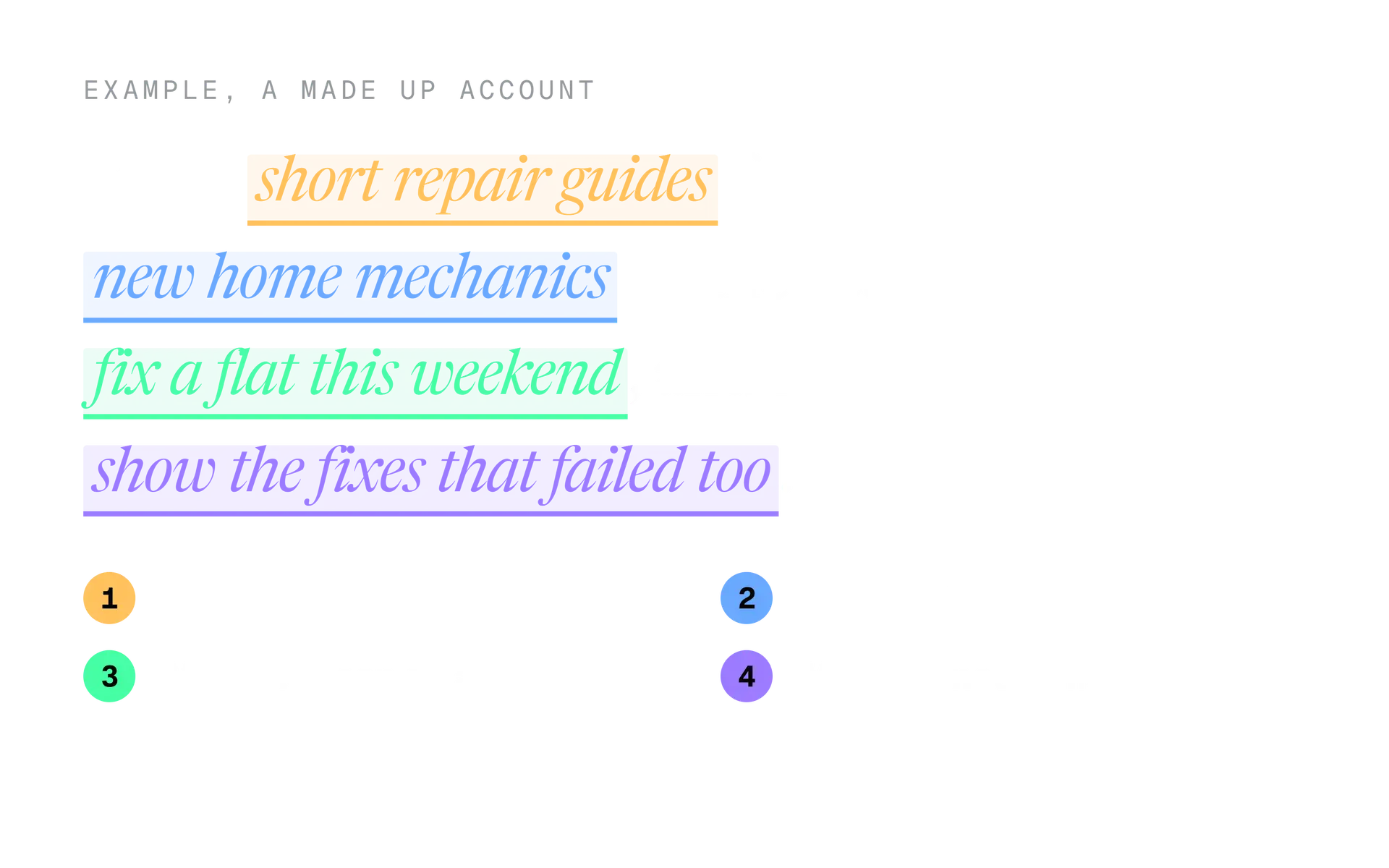
The test is whether a stranger could name an account that would say the same sentence. If a hundred accounts could, the position is a topic, not a position.
A position with an angle
Short repair guides for new home mechanics, with the failed fixes shown too.
A topic with no edge
Cycling content for everyone who loves bikes.
Your profile is where the position gets read. A visitor sees your photo and name, then your bio, then your pinned post. X lets you pin a post to your profile, and it is the first post visitors see. Pin the one that shows what following you gets.
Our guide to X profile optimization goes field by field, and the free bio checker counts each field against X's limits before you save.
How many content pillars do you need?
Three to five. A pillar is a theme you return to again and again: one you could write ten posts on today, that your reader cares about and that leads toward the goal. Fewer than three gets repetitive. More than five and a reader cannot tell what you stand for.
We keep this short on purpose. The aim here is to leave this section with a list you can put on the page.
| Pillar | Its job | The reader's question | Share |
|---|---|---|---|
| Fix guides | Teach one repair | How do I fix this? | 40 |
| Tool tests | Show the work | What should I buy? | 25 |
| Opinions | Take a position | What would you do? | 20 |
| Reader questions | Answer in public | Can you look at mine? | 15 |
The share is how much of the month each pillar gets. Shares do not need to add up to a perfect 100, but they should make it clear which pillar leads. Teaching usually leads, and the others keep the account human and give people a reason to reply.
Turn this table into slots with the free content calendar generator. Give each pillar a share, pick the posting days and 1 to 5 posts a day, set a mix of single posts, threads, images and polls, and download the month as a CSV or calendar file. It runs in your browser, needs no sign up and does not write the posts.
Which formats should you post, and in what mix?
Use the format that fits the idea, and make a plain single post your default. Pick a mix after you have a month of results, not before. A format is a way to carry an idea, so the idea comes first.
| Format | Use it for | What it costs you | Guide |
|---|---|---|---|
| Single post | One idea you can finish in a breath | Minutes | Great X posts, hooks |
| Thread | An idea that needs steps, proof or a story | About an hour | How to write an X thread |
| Image | A diagram, a screenshot, one line in large type | Design time | Image sizes, quote cards |
| Video | Showing a thing happen | Filming and editing | Video on X |
| Poll | A real question you will act on | Minutes | The calendar generator includes polls in its mix |
| Reply | Joining a conversation that already exists | Daily minutes | Replies to grow on X |
Whatever the format, a standard post holds up to 280 characters, every link counts as 23 and every emoji counts as 2, according to X's developer documentation. Our guide to how X counts characters has the rest.
Here is a single post for the Fix guides pillar of the made up account.
My rule for any repair guide: one tool list, five steps, and one photo of the part that went wrong. This week: replacing a brake pad.
How do you choose the mix? The calendar generator opens with 50 percent single posts, 20 percent threads, 20 percent images and 10 percent polls. That is the tool's starting example, not a benchmark. We found no X page or study with a disclosed method that gives an ideal split. Start there, then move a few points a month toward the formats your readers answer.
How often should you post on X?
Post as often as you can keep up for three months. We found no number from X that fits everyone, and in the files and pages we read for our guide to how the X algorithm works there is no posting frequency rule. The honest answer is the rhythm you will actually keep.
The generator's cadence library is a useful menu. Each row is a pattern with who it suits and what to watch.
| Cadence | Posts a week | Fits | Watch |
|---|---|---|---|
| Three a week starter | 3 | New accounts building a habit | Long gaps, so make each post count |
| Tuesday and Thursday deep dives | 2 | Experts writing long threads | Keep threads to half the mix or more |
| Weekday operator | 5 | Most business accounts | Weekends go quiet |
| Daily operator | 7 | Personal brands with weekend readers | You need a buffer of drafts |
| Weekday launch | 10 | A launch or big announcement | Run it for a week or two, then step down |
| Two a day builder | 14 | Teams or a daily news beat | Quality slips first |
Three posts a week you never miss beat two a day that stop after a fortnight. That is Kairo Post's advice, not an X rule, and the same pattern shows up in our growth guide.
There is also a reason to plan fresh angles rather than repeats. In X's published code, the For You feed has a filter that removes posts older than 48 hours before ranking. A post has a short working life, so a good idea deserves a second post with a new angle. An identical repeat is a different matter, and what X does with duplicate posts explains why.
For timing inside the week, use our best time to post guide and the free best time to post planner. They start from where your followers live, not from a list of hours. Then schedule the posts in a weekly batch so the rhythm does not depend on your mood.
How do you keep your voice consistent?
A voice is what makes ten posts by three writers read like one source. Write it down once as part of the strategy, so every draft starts from the same place. Our full guide, how to define a brand voice for X, covers the method. Here is what the strategy page needs from it.
Traits
Three or four traits
Each with a this, not that pair of real lines, so two writers cannot read it two ways.
Words
Two word lists
The words you use and the words you avoid. Our list of AI words to avoid is a good start for the second list.
Tone
Tone rules
How the voice shifts in replies, launches and bad news, while the traits stay the same.
The first line does most of the work in a post. Our guide to X hooks covers seven structures, and the free hook grader checks a line against a clear checklist. To catch stock phrases before they go out, paste the draft into the AI phrase checker.
Where do the ideas come from?
From a small system, not a hunt each morning. Keep one capture list and feed it from your own work, customer questions, replies, X search and Lists, trends and outside sources. Then spend about 15 minutes a day choosing an idea and slotting it into the week. Our guide to content ideas for X walks through the system.
The strategy adds one rule.
Every idea gets a pillar before it gets written. An idea with no pillar goes in a parking list, not in the calendar.
One idea can fill several slots, if each post adds something new. Change the reader, the proof or the format, not just the wording. Here is one idea from the made up account.
| Slot | Format | The angle | Pillar |
|---|---|---|---|
| Monday | Single post | The cause, in one line | Fix guides |
| Wednesday | Thread | The full fix, step by step | Fix guides |
| Friday | Image | A photo of the worn part | Tool tests |
| Next week | Single post | A question: what did you check first? | Reader questions |
If you already publish a newsletter or long articles, turn them into X posts the same way: pull ideas, not paragraphs. Check that no two posts repeat, with the free duplicate post checker.
Do replies belong in your content strategy?
Yes, as a line in the plan with minutes attached. Posts reach people who already follow you and whoever X chooses to show them to. Replies are how you take part in conversations that already exist, and how you answer the people who answer you.
X publishes the code behind the For You feed, and its stated aim is for the public to understand how posts are distributed. These are some of its default weights, as of the file's last sync on 30 September 2026.
| Predicted action | Default weight |
|---|---|
| Reply | 5.0 |
| Quote | 5.0 |
| Follow author | 4.0 |
| Share | 2.0 |
| Repost | 1.0 |
| Like | 0.5 |
Read the table carefully. The README says the weights scale predicted probabilities, not raw counts, and live settings can differ from the defaults. Our reading is modest: write posts a reader might answer, and answer the people who do. Our algorithm guide goes further.
Set the minutes in the strategy
Write a number, such as 15 minutes on posting days. A reply session with no time attached does not happen.
Decide whose posts you answer
Accounts your reader already follows, in conversations still moving, on topics where you know something.
Add one thing each time
An example, a source or a question. How to use replies to grow on X shows what that looks like.
Keep replies by hand
X's API changelog of 23 February 2026 says programmatic replies are only permitted when the original post's author has summoned the replier, by mentioning that account or quoting one of its posts. Read what you can and cannot automate on X before you build a routine around a tool.
How do you measure whether your X content strategy works?
Read the two or three numbers your goal points at, in equal periods, and compare them with your own earlier months. Do not compare them with someone else's account or a benchmark from a blog. We found no X page and no study with a disclosed method that gives an engagement rate to aim for.
3
non public post metrics: URL clicks, profile clicks and engagements
X Developer Platform, Metrics
30 days
how long non public metrics stay available through X's API
X Developer Platform, Metrics
2
impressions counted when one person views a post twice
X Developer Platform, Metrics
Those figures shape how you keep records. The 30 day window is from X's API documentation, so if you want a history, save your numbers every month. Impressions are not unique, so an engagement rate that divides by impressions is a rate per view, not per person.
The strategy adds one habit: tag every post with its pillar and format when you log it. Without those two columns, you can say that a month went well but not why.
| Week | Pillar | Format | Impressions | Engagements | Rate |
|---|---|---|---|---|---|
| 1 | Fix guides | Thread | 4,200 | 126 | 3.0% |
| 1 | Tool tests | Image | 2,500 | 60 | 2.4% |
| 2 | Opinions | Single post | 1,800 | 27 | 1.5% |
| 2 | Reader questions | Single post | 3,000 | 105 | 3.5% |
| 3 | Fix guides | Single post | 5,000 | 140 | 2.8% |
| 3 | Reader questions | Single post | 2,000 | 66 | 3.3% |
Every figure in that table is made up. The rate is engagements divided by impressions, times 100, the formula in our engagement rate guide, and the free engagement rate calculator works it out for you. In this made up month, the two Reader questions posts have the highest rates, and the one Opinions post has the lowest.
To measure visits, tag each link before you post it. The UTM builder builds the tag, and how to track clicks from X explains why X's click count and your web analytics will never match exactly. Kairo Post's analytics can compare topic pillars by engagement, reach or cost, if you would rather not keep the log by hand.
How do you review and adjust every month?
Block 45 minutes on a fixed date, read the numbers, sort what you posted into keep, fix and drop, and change one thing. Then write down what you changed. The review is the part of the strategy that makes it a strategy and not a wish.
Pull the numbers
Collect last month's posts with impressions, engagements and clicks. Do it inside the 30 day window for non public metrics.
Group by pillar and format
Compare like with like. A thread and a single post answer different questions.
Sort into keep, fix and drop
Use the table below. One weak month is a reason to look, not to drop.
Pick one change
One pillar share, one format or one first line. Not three.
Write it on the page
Add the change and the next review date to the strategy page.
| Sort | What it looks like | What to do |
|---|---|---|
| Keep | A pillar or format that holds up in two reviews | Leave it alone |
| Fix | Good idea, weak first line or wrong format | Change one element next month |
| Drop | Low in two reviews and off the goal | Move its share to a pillar that works |
A review note you can act on
Reader questions had the best rate in both months. Next month: move 5 points of share from Tool tests to Reader questions. Change nothing else.
A note that decides nothing
Engagement was down a bit. We should post more and try new things.
Once a quarter, step back further. Read three reviews in a row, then ask whether the goal, the reader and the position still hold.
Month 1
Run the plan as written
Keep the rhythm. Log pillar and format on every post. Review on the date you set.
Month 2
Change one thing
Apply the single change from the review. Leave everything else alone.
Month 3
Compare and decide
Compare three months of your own numbers. Keep, fix or drop what the pattern shows.
Quarter end
Rewrite the page
Update the goal, the reader and the position. Choose the next quarter's goal.
A one page X content strategy template
Here is the page, filled in for the made up account. Use the same nine rows for your own account, and keep it to one side of paper.
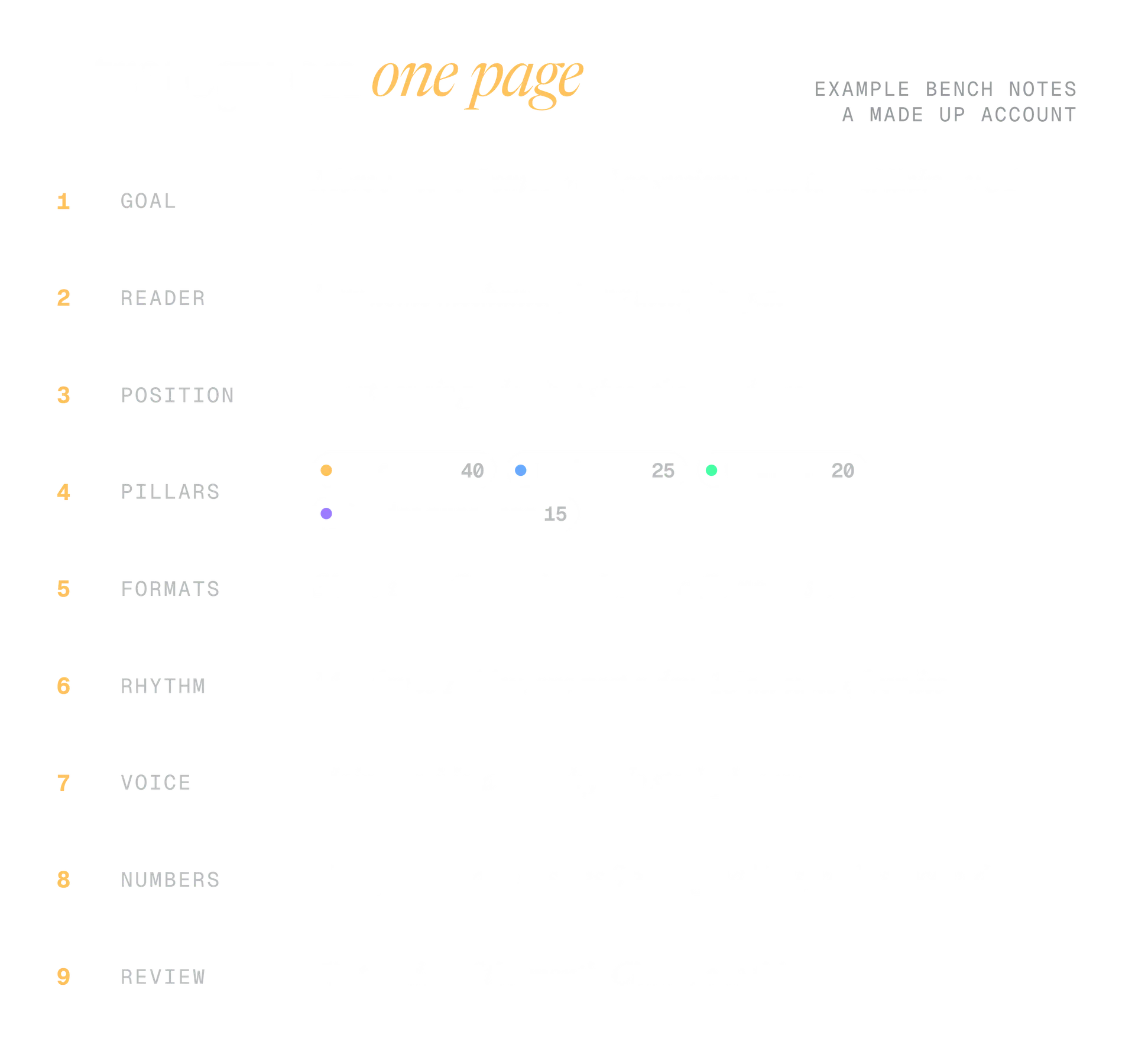
Copy this into a note and fill it in.
X CONTENT STRATEGY, ONE PAGE
Account:            Quarter:            Next review:

1. Goal:       one result, one number, one date
2. Reader:     who, what they want this month, their own words
3. Position:   I post [what] for [who] so they can [outcome], and I [angle]
4. Pillars:    3 to 5 themes, each with a share
5. Formats:    the default format, and when a thread, image or video is worth it
6. Rhythm:     posting days, posts a day, reply minutes, time zone
7. Voice:      3 traits, words we use, words we avoid
8. Numbers:    the 2 or 3 numbers, and how each one is worked out
9. Review:     the date, who comes, and the rule: change one thing
Fill the first three rows without looking anything up
Goal, reader and position come from what you already know. If you cannot answer one, that is the work for this week.
Add pillars and rhythm
Use the earlier sections. Then turn the shares and the days into a month with the content calendar generator.
Write the numbers and the review date last
They are the rows people skip, and the ones that keep the page alive.
A shorter version for a very small account
If one person posts a few times a week, four rows are enough to start: the reader, the position, three pillars and the review date. Add the goal and the numbers once you have a month of posts to look at.
Content strategy for teams and client accounts
A team or client account needs the same page with three extra lines: who writes, who approves and who replies. Without them, drafts wait for a second approval nobody owns and replies go out late or not at all.
If several people write, the voice guide does the work. Our guide to managing X for clients covers access, approvals, replies and reporting, and the brand voice guide shows how to keep several writers consistent.
Running more than one account? Give each account its own strategy page and its own angle. X's Developer Policy says never to post identical or substantially similar content across multiple accounts, and our duplicate posts guide covers the rule for posting by hand.
Mistakes we see in X content strategies
These are patterns we see, not statistics. Most are easy to fix once you spot them.
- Two goals at once. Half the posts chase visits and half chase followers, and neither number moves.
- A topic list instead of pillars. "Marketing, tips, news" is a shelf, not a pillar. A pillar names a job for the reader.
- Choosing a format because a guide said it gets reach. The idea decides the format.
- A rhythm set for your best week. It falls apart in week three. Set it for an ordinary week.
- No minutes for replies. The plan has posts and no conversations.
- Reading only the follower count. It rises slowly and says nothing about why.
- Changing three things at once. Nobody knows which one helped.
- Copying another account's strategy. Their reader and goal are not yours.
- A plan in a file nobody opens. If the team cannot say it aloud, it is not used.
Your next step: put it on one page this week
You do not need a tool, a template pack or a big block of time. You need an hour, the nine rows and a review date. After that, the strategy does its job by making each post a smaller decision.
Before your next post
- One goal, written as a result, a number and a date.
- A reader card with their own words.
- A position sentence with an angle.
- Three to five pillars, each with a share.
- A rhythm you could keep on an ordinary week, with reply minutes.
- Two or three numbers, and how you work out each.
- The date of your first monthly review.
If you want the planning and scheduling in one place, Kairo Post lets you set topic pillars and the share each should get, and Campaigns can plan a whole month around them. It is one way to keep the rhythm. The page above works on paper.
Run the plan for a month, read your numbers, change one thing, and run month two.
In the product
How Kairo Post does this
Everything above works by hand. Kairo Post does the same work for you, with your approval before anything goes out.
Questions people ask
How long should an X content strategy be?
How often should I update my X content strategy?
Is there an ideal mix of posts on X?
Should I post the same content on X and on my other platforms?
What is the difference between a content strategy and a content calendar?
What if my strategy is not working after a month?
Do I need a content strategy for a small personal account?
Sources
Every rule, limit and figure in this post was checked against these on the date shown.
- Counting Characters, X Developer Platform
docs.x.com · checked
- Metrics, X Developer Platform
docs.x.com · checked
- X For You feed algorithm, X on GitHub
github.com · checked
- Home Mixer parameters, X on GitHub
github.com · checked
- X Developer Policy, X developer documentation
docs.x.com · checked
- X API changelog, X developer documentation
docs.x.com · checked
- How to customize your X profile, X Help Center
help.x.com · checked
Written by