X for business: playbooks for every industry
The short answer
To use X for business, pick one goal, build a complete profile, post a few repeatable kinds of useful posts, answer people where they ask and count clicks you have tagged. Then set the lead job by industry: updates for software, expertise for services, proof for products, today's news for local shops.
Key takeaways
- Choose one goal for your first 90 days, because the goal decides what you post and what you count.
- Switch to a free professional account, fill in the profile and pin a post that says what you offer.
- Reply in public first, move private details to a Direct Message and never automate welcome messages to new followers.
- Tag every link. X counts a link as 23 characters however long it is, so a tagged link costs you nothing extra.
- Your industry sets the lead job: SaaS shows what shipped, services teach, shops show the product, local businesses say what is on today, and nonprofits tell one real story with consent.
You run a business, and you keep hearing that you should be on X. A customer tagged you once, or a competitor seems to be everywhere. The useful question is not whether X works. It is what X for business should do for yours, and how much of your week it deserves.
This is the main guide to our industry playbooks. The first half covers what every business needs: a goal, an account, a posting plan, a way to look after customers, ads in brief and a way to measure. The second half gives you a short playbook for 7 kinds of business, with a link to the deeper guide where we have written one. Game developers have their own playbook.
Is X worth it for your business?
X is worth a serious try when three things are true: your customers already talk about your topic there, you can say something useful every week, and someone can reply within a working day. If one is missing, fix it first or spend the time somewhere else.
- Your people are there. Search the words your customers use for their problem. If nobody posts about it, you would be talking into an empty room.
- You have something to say. A useful post a week should come from work you already do. If you have to invent material, you will run dry.
- Someone can reply. An account that posts and never answers looks closed. Name a person and give them a daily slot.
We found no sourced benchmark for how X performs by industry, so we quote none. Treat the first quarter as a test. At the end, judge it by the conversations that mattered and by the visits, signups or orders you can trace to a tagged link. Two playbooks for young companies: X for startups and X for AI companies.
What goal should your business have on X?
Pick one goal for your first 90 days. The goal decides what you post and what you count, and two goals pull the same post in opposite directions. A post written to teach rarely sells, and a post written to sell rarely teaches.
| Goal | Post mostly | Count this |
|---|---|---|
| Be known for something | Teaching posts and useful replies in your topic | Impressions, and followers who match your buyer |
| Get leads or orders | Proof, with one tagged link | Tagged clicks, then signups or orders that carry the tag |
| Serve customers | Answers, status updates and replies | Time to first reply, and questions solved in public |
| Hire | Behind the scenes and how the work gets done | Applicants who say they came from X |
| Build trust before a launch | Honest progress and answers to early questions | Replies from people in your target group |
Write the goal as a sentence you can check later, such as "Answer every customer question within a working day" or "Send 20 visits a week to the booking page from tagged links". Those are examples, not targets.
Then turn the goal into a plan with our X content strategy guide. It walks through audience, positioning and a monthly review. For the themes you will keep returning to, see content pillars for X.
How do you set up a business account on X?
Set up one complete profile, switch it to a professional account, pin a post that explains what you do and secure the login. It takes an afternoon, and every visitor you ever send to the account sees it first.
Pick the owner and the name
Use the name and handle customers already know from your website and receipts. Decide who owns the login before anyone starts posting.
Switch to a professional account
The switch is free. Choose Business for an organisation, brand or shop, or Creator for a public figure. Our professional account guide walks through it.
Write a bio that answers three questions
What do you do, for whom, and what should a visitor do next? The free X bio checker checks your name, handle and bio against X's limits.
Pin one post
X lets you pin a post so it is the first thing people see on your profile. Use it for a plain description of what you offer and one tagged link.
Lock the door
Use a unique password and two factor, and share access without sharing the password. See how to secure your X account and how to manage several accounts.
The free switch does not give you a checkmark. A gold checkmark comes through Premium Business, which is for organisation accounts and goes through a review. Our guide to X verification badges explains each option. Prices change, so read X's own page for the current ones.
A professional account also unlocks Profile Spotlights, which let a business show details such as opening hours, a shop window or a button. We use them in the local business and ecommerce playbooks below. For a field by field check of the rest, use X profile optimization. Four more playbooks: ecommerce brands, journalists, coaches and consultants and podcasters.
What should a business post on X?
Post what answers the questions a buyer asks before they trust you. There are five of them, and each has a kind of post that answers it. You do not need all five every week, and your industry decides which one leads. Four more playbooks: restaurants and cafés, real estate agents, nonprofits and authors.
| The buyer asks | The kind of post | A made up example |
|---|---|---|
| What is new? | News | The autumn range is in the shop from today |
| How do I do this? | Teach | Three ways to keep a candle burning evenly |
| Will it work for me? | Answer | Yes, it fits a tall jar. Here is how |
| Why should I trust you? | Proof | A photo of the workshop where this week's orders were made |
| Who are these people? | People | The person who answers your emails, in one photo and two lines |
Start with an even mix and let your goal move it. Teach and answer posts keep paying off, because people find them when they search for the problem. News has a short life, so save it for when something really changed.
Three habits make any of them easier to read:
- Lead with the point. Put it in the first line. X hooks shows how, or paste a draft into the free hook grader.
- Write the way your customers talk. Brand voice for X helps you find that voice.
- Add alt text to every image. Our alt text guide covers it.
If you run out of ideas, content ideas for X gives you a way to collect them from your own customers. And for a story that needs several parts, write a thread.
How do you handle customer support on X?
Reply in public so people see you are there, move private details to a Direct Message, and say in public when it is fixed. X's business guidance has the same shape: reply even when you cannot help yet, put your support hours on your profile, and take sensitive exchanges to Direct Messages.
| Say in public | Take to a Direct Message |
|---|---|
| We saw this and we are looking into it | Order numbers, emails and addresses |
| The fix, once it is done | Account and payment details |
| Opening hours and links to help pages | Anything the customer would not want strangers to read |
Name one person who owns replies each day. Put your support hours in the bio, then promise only what you can keep. "We reply on weekdays" is better than "within the hour" if you cannot do it.
If several people share the account, a shared inbox helps. The Kairo Post Inbox collects mentions for your accounts and drafts replies that a person reviews and sends. For a full routine, read community management on X, and for criticism, how to handle negative comments.
How do you run a launch or an offer on X?
Run it in three phases: build the ground before, run the day deliberately, and follow up after. The launch is one day, but the replies and the follow up decide whether it was worth it. Our product launch guide covers each phase in depth.
The week before
Prepare
Write the post you will pin, tag the links, brief anyone who will post about it and decide who answers questions on the day.
Launch day
Post, pin, reply
Publish one clear post with one tagged link, pin it, and spend the day replying. Keep the first post readable on its own.
The day after
Thank and answer
Thank people in public, answer what is left and note which questions came up twice.
The week after
Report and share
Read the tagged clicks, then share what happened or what you learned. A launch that ends in silence wastes the attention it earned.
Offers and giveaways come with rules of their own. Before you run one, read X giveaway rules in plain English. If you post from more than one account, do not post the same words from each. X's developer guidelines list identical content across several accounts as spam or platform manipulation, and X duplicate posts explains where the line sits.
Should your business run ads on X?
Not on day one. Post for long enough to know which posts earn replies and tagged clicks, then pay to extend the ones that already work. Ads buy reach, but they cannot make an unclear post clear.
Each X Ads campaign is built around one objective, such as reach, video views, website traffic, engagement or app installs. X optimises the campaign towards that objective and bills you for actions that match it. The labels in Ads Manager can differ from the names in the developer documentation, so read the screen in front of you.
| Organic posts | Ads |
|---|---|
| You pay with time | You pay with money and time, at prices X sets in Ads Manager |
| Best for finding out what people respond to | Best for putting a proven post in front of more of the right people |
| Slow, and it compounds | Quick, and it stops when the budget stops |
A professional account includes Quick Promote, which turns a post you already published into an ad without opening Ads Manager. Advertising also means following X's Ads Policies and advertiser eligibility rules, and your content must still follow the X Rules.
Set the bar before you spend. Write down what a good result looks like for one post, in tagged clicks or replies, then promote it and compare. Without a number chosen in advance, every result looks like a success. We give no prices here because X sets them in Ads Manager and they change.
How do you measure X for business?
Pick one outcome number that matches your goal, add three habit numbers and look at them once a month. The outcome tells you whether X is working for the business. The habit numbers tell you why.
| Number | Kind | Where it comes from |
|---|---|---|
| Visits, signups or orders from tagged links | Outcome | Your own analytics, with UTM tags on every link |
| Link clicks and impressions per post | Habit | X's analytics for your own account |
| Engagement rate | Habit | Engagements divided by impressions, as X defines it |
| Replies answered, and time to the first reply | Habit | Your own log |
Tag every link with UTM parameters. Google Analytics says to always use utm_source, utm_medium and utm_campaign, and that parameter values are case sensitive, so choose lowercase and keep to it. The free UTM builder makes the link, and how to track clicks from X explains why X's numbers and your analytics never match.
Two limits to know. Impressions count every time a post appears on a screen, and the same person seeing it twice counts twice, so they measure exposure, not people reached. And X's developer documentation treats link clicks, profile clicks and engagements as non public metrics, readable only with the account owner's authorisation, so you cannot pull a competitor's.
A 20 minute monthly review
- Open your outcome number and write it next to last month's.
- List your 3 best and 3 weakest posts by replies and tagged clicks.
- Ask what the best ones had in common: the kind of post, the first line, the picture.
- Choose one change for next month, and write it down.
For the formula and a worked example, read how to calculate X engagement rate, or use the free engagement rate calculator.
How does X for business change by industry?
The foundation is the same for every business: one goal, a complete profile, useful posts, fast replies and tagged links. What changes is who you are talking to, what they need before they trust you and what can go wrong. That decides the lead job of your account.
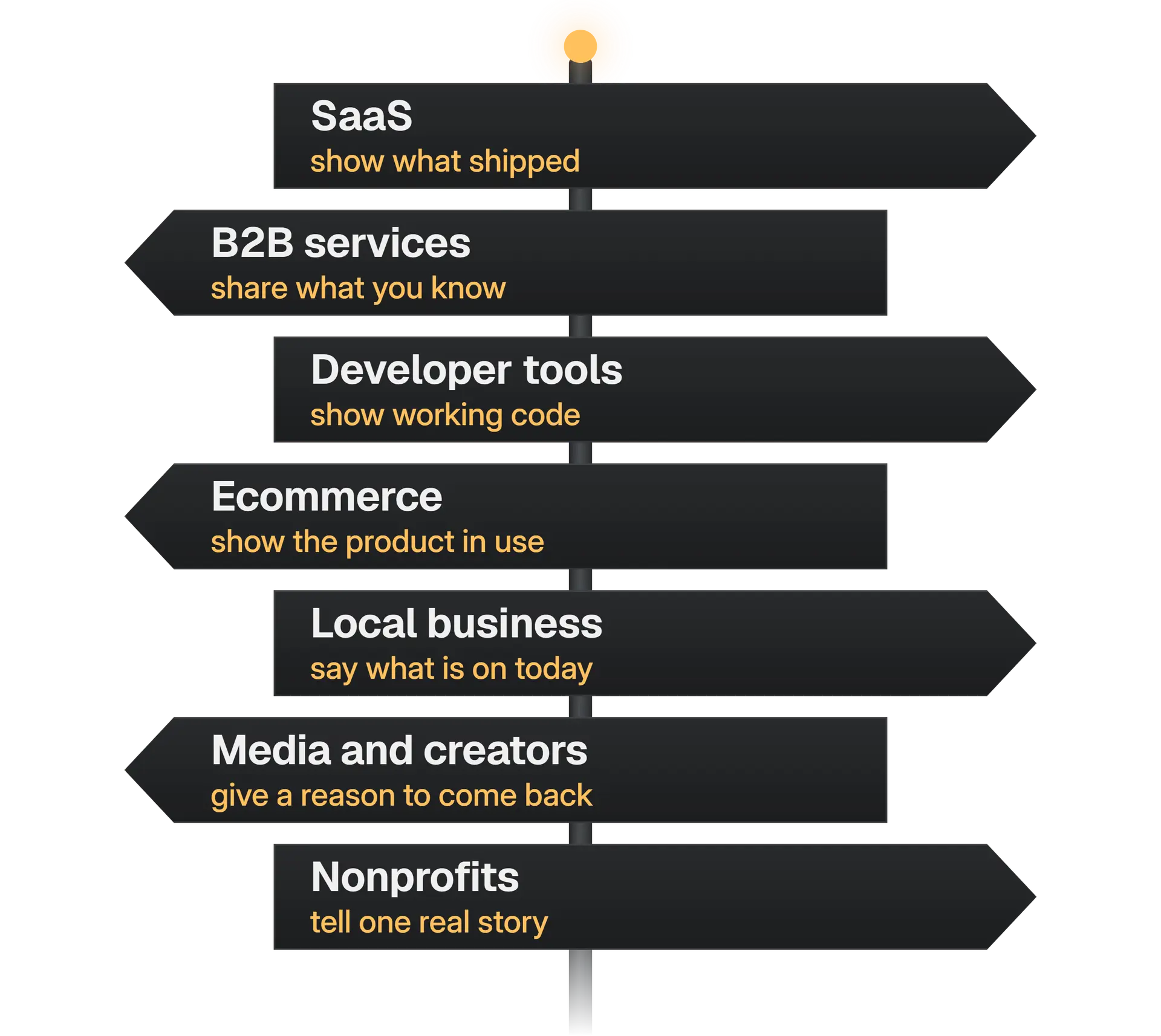
Find your business below. If it sits between two, lead with the job of the one that brings in the money and borrow one habit from the other.
SaaS companies: show what shipped and answer in public
Software buyers are choosing a team they will rely on for a long time, so the lead job is to show the product moving and the people behind it. Software also changes often, which gives you a steady supply of true news.
| What works | What to avoid |
|---|---|
| One change per update post, in the customer's words, with a screenshot | A pasted changelog nobody can picture |
| Answering a question customers keep asking, in public, with the docs linked | Identical posts from the company and founder accounts |
| A company account for the facts and a founder account for the story | Automated welcome messages to new followers, which X's developer guidelines do not allow |
Our full playbook is X marketing for SaaS. If you are earlier than that and still finding your first users, borrow from build in public.
B2B services: teach one small thing at a time
People hire a firm to be right, so the lead job is to show how you think. A useful post is a small sample of the work. Imagine a fictional firm, Northline Accounting, writing for owners of small shops.
Teach one small thing (an example)
Three questions to ask before you change payroll provider. The second one is the one people forget.
It shows judgement, and the reader can use it today.
Announce something nobody asked about
We are thrilled to announce a new partnership with a leading provider.
It says nothing about how you think, and nobody can reply to it.
Use search to find the questions your buyers ask and answer them with a thread. Do not reply in bulk to people you have never spoken to. X's authenticity policy prohibits bulk, aggressive, high volume unsolicited replies, mentions and Direct Messages.
Partners and senior staff are often your best voices and your busiest people. X ghostwriting covers how to write in someone's name honestly. The deeper guide for this playbook, X for B2B marketing, is still to come.
Developer tools: show working code and honest limits
Developers trust what runs. The lead job is to show working code, say what it does not do and make it easy to try. A short demo clip or a thread that walks through one example usually does more than a feature list.
Before you post about a release
- The example in the post runs when someone copies it.
- The post says what changed and what might break.
- The link goes to the docs or the changelog, and it is tagged.
- Someone who can fix issues is watching the replies that day.
- You thanked the person who reported the bug, if they agreed to be named.
Avoid vague claims such as "faster" with no method behind them, and avoid hiding a breaking change in the middle of a thread. For demos, see video on X, and for long walk throughs, how to write an X thread.
Ecommerce: show the product and answer before it becomes a return
Shoppers buy what they can see and trust. The lead job is to show the product in use, announce restocks and drops on a date, and answer sizing and delivery questions in public so the next shopper does not have to ask.
Back in stock today: the cedar and orange candle. Trim the wick before each light and it burns evenly. Orders ship Monday to Friday.
- A professional account can add a Shop Spotlight to show products. X's help page says availability is limited and varies, so check yours.
- Disclose incentives. The FTC says free products or other incentives given to reviewers should be disclosed.
- Ask before you share a customer's words or photo. X prohibits sharing private media of individuals without consent. Quote public praise by linking to it, or ask first.
Praise you have permission to use can become a picture with the free quote card maker. For picture sizes, see our X image sizes guide.
Local businesses: say what is open, on or new today
People find a local business by walking past or being sent there. The lead job is to say what is open, on or new nearby today. Your posts do not need to travel far. They need to be right for people within reach of your door.
Daily
Today
Opening hours, the special, a late closing, a sold out line. Short and dated.
Weekly
This week
An event, a new product, a seasonal change. One post, pinned if it matters.
Local
Your street
Thanks to regulars, nearby businesses, local news. It shows you belong there.
Cinnamon buns are out of the oven. We close at 3 today, so come before then. The seeded loaf is Saturday only.
A professional account can show your address, opening hours and contact details through Location Spotlight. At its launch in 2022 it was limited to accounts in the US, UK, Canada and Australia, so check whether it is open in your country. Scheduling the week's regular posts frees you to reply in real time.
What to avoid: posting once a month and wondering why it is quiet, a closing time that is out of date, and photographing customers without asking.
Media and creators: give people a reason to come back
Publishers and creators sell attention and trust. The lead job is a format people recognise and a short path from a post to the thing you own, such as a newsletter, a show or a paid tier. Each post should be worth reading on its own.
| If you want to | The post does this | Read next |
|---|---|---|
| Grow a newsletter | Gives one idea from the issue and links the signup | Newsletter to X posts |
| Earn from your audience | Shows what you offer and who it is for | X subscriptions |
| Show your work | Plays a short clip with captions | Video on X |
| Understand what X pays | Follows X's current creator rules | Make money on X |
Avoid posting the same newsletter text again and again. X's Authenticity policy does not allow repeatedly posting identical or nearly identical posts. To bring a good post back, quote it with a new comment. Avoid clickbait you cannot back up, and read the disclosure rules for sponsors in make money on X before you take one.
Nonprofits: tell one real story, with consent
People give, volunteer and share because of a person and a reason. The lead job is to tell one real story at a time, with permission, and to say plainly what you want people to do next. Think of a fictional food bank, Tidewell, asking for volunteers on Saturday.
Before you tell a story about someone you help
- They agreed, and they saw the words and the picture first.
- No private details or private media are in the post. X prohibits sharing them without consent.
- The post says what you want: give, volunteer, share or attend.
- Volunteer calls give the date, the place and what to bring.
- You thank donors and volunteers in public, with their permission.
Premium Business accepts organisation accounts such as nonprofits, if you want a gold checkmark and affiliate badges for related accounts such as support or recruiting. Our verification badges guide explains how they work.
Avoid posting only when you are asking for money, and avoid giveaways with unclear rules. We left out any ad programme for nonprofits because we could not confirm a current one on X's own pages.
What mistakes do businesses make on X?
The same few mistakes appear in almost every business account we look at. Most are about habit, not talent.
- No goal. Posting to be present gives you nothing to measure and nothing to change.
- Every post sells. A feed that only asks gets scrolled past.
- Links without tags. You will not know which posts brought anyone.
- Silence in replies. An account that posts and never answers looks closed.
- Automation that breaks the rules. Welcome messages to new followers and replies to anyone who mentions a keyword are the usual ones.
- The same words from every account. Duplicate posts get limited, and they look lazy.
- No owner. The account everyone can post from is the one nobody checks.
- Judging too soon. A quarter is a fair test. Two quiet weeks are not.
Your first 30 days on X for business
You do not need to do everything at once. Do the setup in the first 3 days, spend a week listening and replying, then post steadily and review on day 30.
Days 1 to 3
Set up
Choose the goal, write the bio, switch to a professional account, pin a post and secure the login.
Week 1
Listen and reply
Run the listening test, write 5 posts, tag every link and spend 15 minutes a day replying.
Weeks 2 and 3
Post and log
Post about 3 times a week from the mix that fits your industry. Note the questions that come up twice.
Day 30
Review
Run the 20 minute review: one outcome number, three habit numbers and one change.
How much time is that? Our starting plan for one person is about 3 hours a week. It is a rule of thumb, not an X figure. Change it once you see which part earns its time.
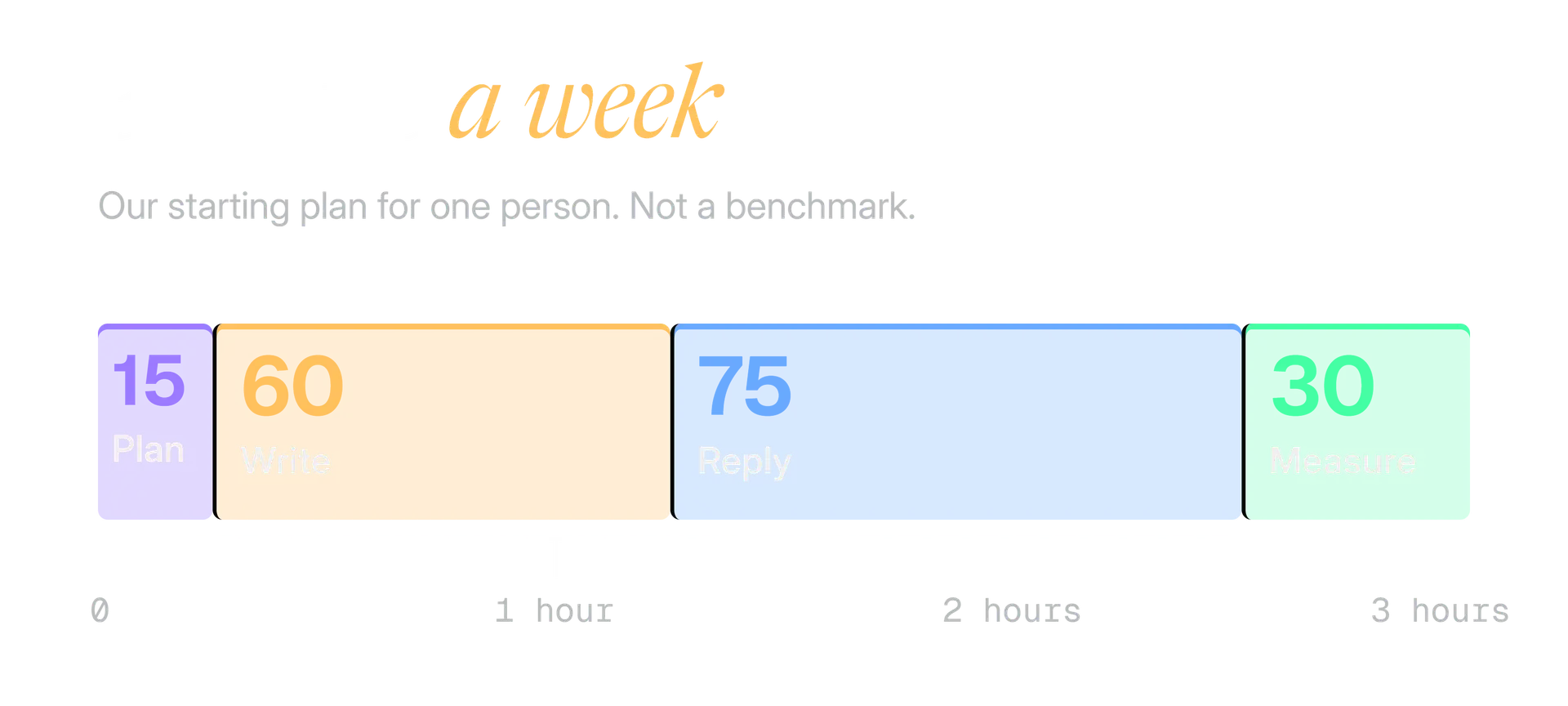
Lay the month out with the free content calendar generator, and check the hours your audience is awake in our guide to the best time to post on X. If a team or several brands share the work, Kairo Post's accounts and teams lets you connect X accounts, group them by brand or client and give each person the access they need.
In the product
How Kairo Post does this
Everything above works by hand. Kairo Post does the same work for you, with your approval before anything goes out.
Questions people ask
Is X good for small businesses?
Do I need a professional account to use X for business?
How much time does X for business take?
Should a business pay for ads on X?
Can my staff post about the business from their own accounts?
Can I send an automatic welcome message to new followers?
What if my business is in a regulated industry?
Sources
Every rule, limit and figure in this post was checked against these on the date shown.
- Counting characters, X developer documentation
docs.x.com · checked
- Developer Guidelines, X developer documentation
docs.x.com · checked
- Metrics, X developer documentation
docs.x.com · checked
- Campaign management, X Ads API documentation
docs.x.com · checked
- Campaign Objectives, X Business
business.x.com · checked
- Community management, X Business
business.x.com · checked
- Professional Accounts, X Help Center
help.x.com · checked
- Premium Business, X Help Center
help.x.com · checked
- Private information policy, X Help Center
help.x.com · checked
- Location Spotlight launch, TechCrunch (15 June 2022)
techcrunch.com · checked
- UTM parameters, Google Analytics Help
support.google.com · checked
Written by